
Leadership is Not a Vote
Leadership by committee sounds wise until the future demands courage.
The Promised Land was visible. The opportunity was real. The abundance was undeniable.
Even so, an entire generation walked away from it because the majority report carried more weight than God's promise.
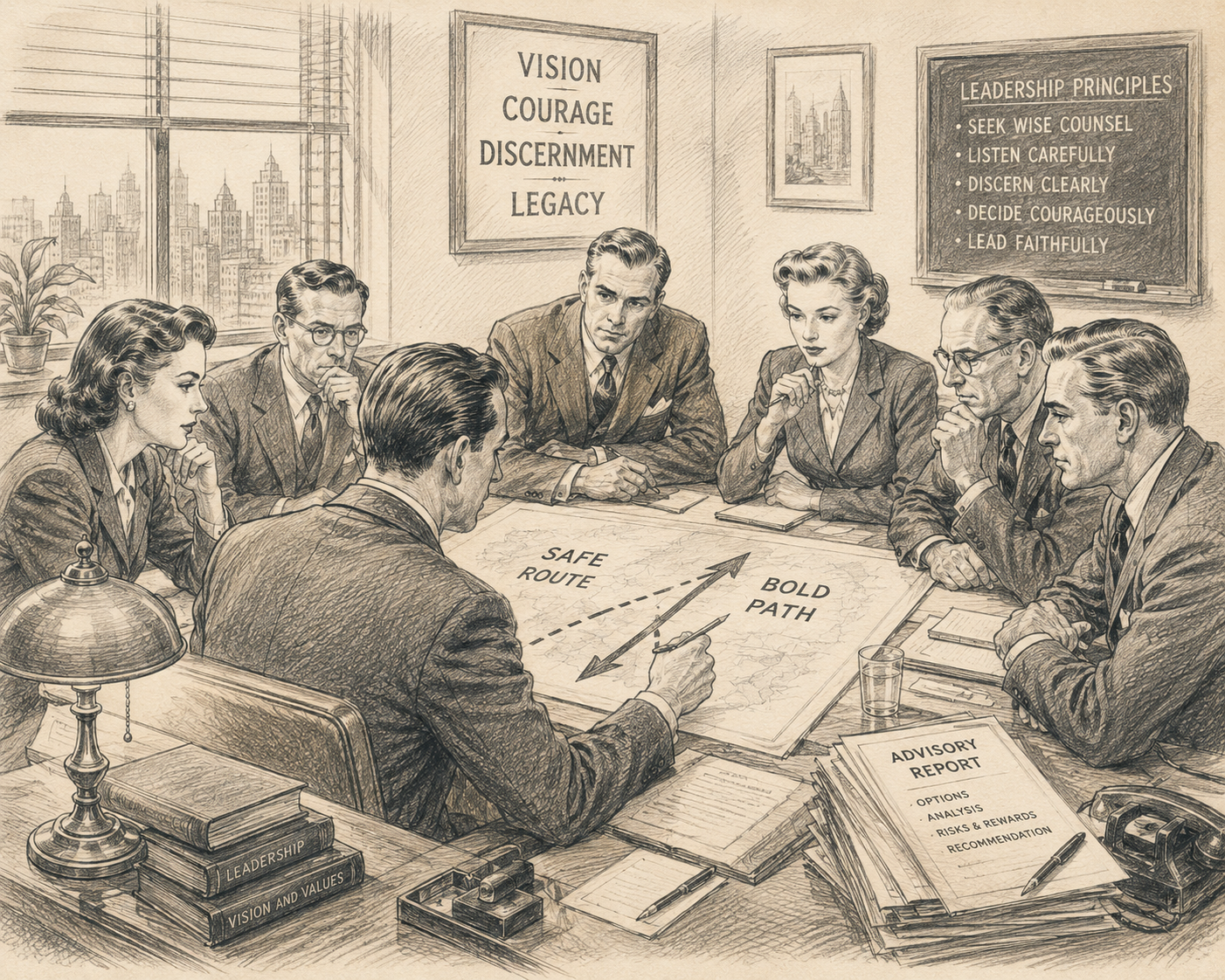
This well-known biblical story raises an uncomfortable question for leaders: What must we do when the majority is wrong?
Leadership books rightly emphasize the importance of seeking wise counsel. Scripture does as well.
Plans fail for lack of counsel, but with many advisers they succeed. (Proverbs 15:22)
For lack of guidance a nation falls, but victory is won through many advisers. (Proverbs 11:14)
Wise leaders seek counsel. Foolish leaders isolate themselves. Prideful leaders assume they already know the answer. My work with our Convene teams is built on this solid foundation.
None of us sees the whole picture. We all have blind spots. We all benefit from the perspectives, experiences, and wisdom of others.
The higher the stakes become, the more voices we tend to gather around the table. Advisors. Experts. Consultants. Board members. Trusted friends.
Their perspectives are invaluable. But…
Some of the most important decisions you will make as a leader are the very decisions that the majority will oppose.
This is where leadership gets difficult. And lonely.
One of the great challenges of senior leadership is learning the difference between counsel and consensus.
Counsel informs leadership. And, unfortunately, consensus can often replace it.
The distinction matters because committees and councils have a natural tendency toward risk avoidance.
That is not necessarily a flaw. In many cases, it is a feature. Groups are often excellent at identifying potential problems, unintended consequences, and hidden dangers. They can protect us from foolish decisions and reckless behavior.
But without courageous leadership, groups also tend to drift toward safety, caution, and preservation. Toward the known.
In a previous article (Safety Third) I noted that yes, safety matters. It should absolutely be considered. But when safety becomes the highest value, mission inevitably suffers.
The same principle applies here.
The goal of leadership is not merely to avoid loss. It is to pursue what matters most.
Which brings us back to twelve men standing at the edge of the Promised Land.
Moses sent one leader from each tribe to survey the land God had promised Israel. Forty days later, they returned with their report.
All twelve agreed on the facts:
The land was incredible.
The crops were abundant.
The opportunities were extraordinary.
All twelve also agreed on the challenges:
The cities were fortified.
The obstacles were significant.
The enemies were formidable.
The majority report was factually accurate:
There really were giants.
There really were fortified cities.
There really were significant risks.
What the majority got wrong was their conclusion.
Ten leaders looked at the obstacles and concluded the mission could not be accomplished.
Two leaders – Joshua and Caleb – looked at the same facts and reached an entirely different conclusion.
If the Lord is pleased with us, he will lead us into that land, a land flowing with milk and honey, and will give it to us. (Numbers 14:8)
The difference was not information. The difference was interpretation. The ten asked: "Can we do this?" Joshua and Caleb asked: "Did God say we should?"
The majority focused on the size of the challenge. The minority focused on the faithfulness of God. The majority won the argument, and an entire generation paid the price.
Israel wandered in the wilderness for forty years because fear carried the day.
Joshua and Caleb stood nearly alone. In reward for their faithfulness, they were the ones who entered the land forty years later.
The majority won the vote. The minority inherited the promise.
There is a lesson here for us as leaders. Leadership requires listening. Leadership requires humility. Leadership requires seeking counsel.
But leadership also requires deciding.
At some point, the data has been gathered, the advisors have spoken, the risks have been identified, the alternatives have been considered, and someone must choose a direction.
When the decision is big, that responsibility cannot be delegated to a committee.
Every advisor gets a voice, but not every advisor gets a veto.
This is one of the many reasons leadership can be lonely. The responsibility ultimately rests with the leader - not the committee, not the board, not the consultant, and not the crowd.
The leader.
The leader's responsibility is not to count votes. The leader's responsibility is to discern the right path and move forward with courage.
There is a reason Scripture encourages us to seek many counselors.
But after every voice has been heard and every concern has been considered, leadership still demands a decision. And that decision cannot be outsourced.
Because leadership is not a vote.
Blessings to you, my friends!
==========
This Week’s Resource Recommendation:
"The Leadership Challenge: How to Make Extraordinary Things Happen in Organizations"
- James M. Kouzes & Barry Z. Posner
From Amazon: In the new seventh edition of The Leadership Challenge: How to Make Extraordinary Things Happen in Organizations, best-selling leadership authors and business scholars James Kouzes and Barry Posner deliver an essential strategic playbook for effective leadership. The book’s actionable advice is grounded in robust research and deep insights into the complex interpersonal dynamics of the workplace.
Premier authorities in the field, the authors frame leadership as both a skill to be learned and as a relationship to be nurtured. They demonstrate how to achieve extraordinary results in the face of contemporary business challenges with engaging stories, current case studies, and straightforward frameworks for those who seek continuous, incremental improvement.
The book also offers:
Incisive commentary on the shift toward team-oriented and hybrid work relationships
Key insights into how to break through a new and pervasive level of cynicism amongst the modern workforce
Strategies for leveraging the electronic global village to deliver better results within your team, in your department, and across your organization
Perfect for every practicing and aspiring leader who wants to stay current, relevant, and effective in a rapidly evolving business environment, The Leadership Challenge will help you remain impactful and capable of inspiring and motivating your constituents at every level.
MMS 26-22
I would love to send our Monday Morning Stretch directly to you via email and would consider it an honor to serve you in this way. To register, please take 30 seconds to give us permission to do so below.
