
Risk Comes With the Ride
In 1985 I bought a used 1982 Yamaha XJ750 Maxim. That same motorcycle is sitting in my garage today. Reflecting on the 40 years between those two moments brought me to today’s Stretch.
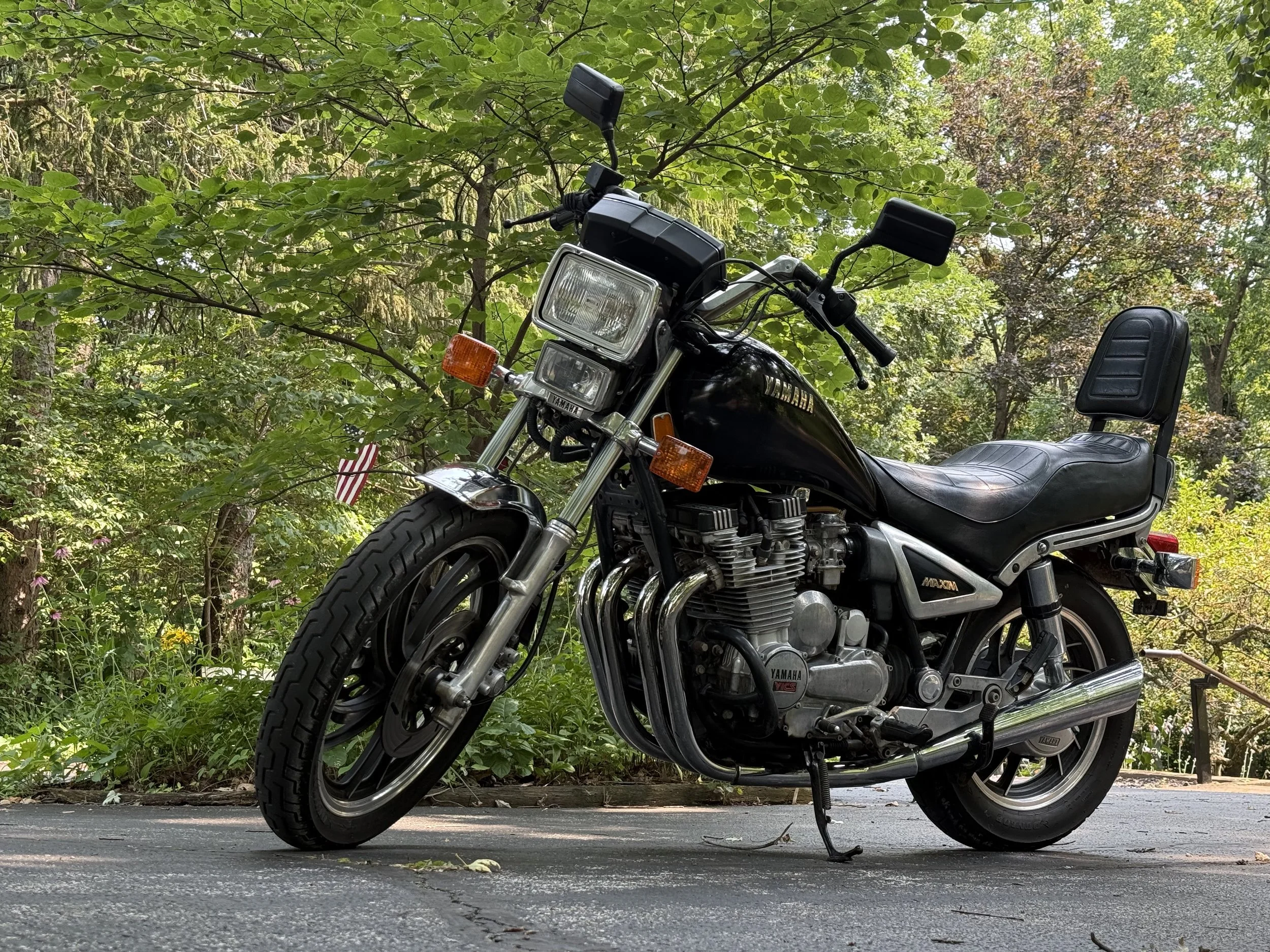
Though I had loved motorcycles for as long as I could remember, they were off-limits to me as a kid.
I understand why.
There’s nothing particularly safe about sitting on top of a powerful machine traveling at highway speeds with no seat belt, no airbags, and virtually nothing surrounding you except open air.
Motorcycles are risky. They’re also incredibly fun!
The acceleration. The sound of the engine between your knees. The maneuverability. Leaning into a curve.
You are IN the environment.
You feel the temperature change as you drop into a valley. You smell freshly cut grass, trees, fields, and streams – along with a few things you wish you couldn’t.
You buffet the wind and watch terra firma moving just beneath your feet.
There is something wonderfully primitive about it. A motorcycle is akin to a modern-day horse, combining transportation, skill, exposure, and a type of freedom you can’t experience in a cage (motorcycle slang for an enclosed vehicle).
There is also an awareness of our willingness to engage in an activity not everyone can, or is willing to, do.
Motorcycles have a risk barrier many choose not to cross.
That’s a distinction, not a value judgment. Riders simply make a different calculation about risk and reward.
For instance, I have absolutely no desire to go skydiving. As the saying goes, why would I jump out of a perfectly good airplane? Of course, a skydiver could ask why I would willingly travel seventy miles per hour on two wheels surrounded by distracted drivers.
Fair point.
We all make these calculations. Adventure involves risk. So do relationships, faith, parenting, starting something new, and leading anything of consequence.
Each of us decides which risks are worth accepting in exchange for the life we hope to experience.
It took me a while to recognize how much this principle applies to leadership.
My perspective took a drastic turn once I realized leadership’s associated risks needed to be embraced and mitigated, not eliminated, because they are part of the price of freedom.
I didn’t always think that way.
My professional formative years were immersed in a corporate mindset. Systems, structures, controls, predictability, policies, and processes were everywhere. The walls were secure. It felt very safe.
When I left corporate America for full-time ministry, I discovered a very different leadership environment. Eventually, I ventured back into the world of for-profit business and saw leadership from yet another angle.
This variety of experiences changed me – most notably when I realized both corporate and ministry safety nets are nothing more than an illusion.
Life, faith, and leadership change when you embrace the reality of their associated risks.
You and I have the freedom to create something where nothing existed before – to solve problems, build teams, serve customers, create jobs, make decisions, change direction, experiment, grow….
To fail, and to try again!
There is enormous freedom in that, of course, but there’s also enormous risk. The two are fundamentally connected.
We cannot experience the intense freedom of ownership while simultaneously demanding the certainty of a guaranteed outcome.
It doesn’t work that way.
A few years ago, I was introduced to one of my favorite leadership books, “A Failure of Nerve” by Edwin Friedman, today’s resource below.
I return to it frequently because Friedman explores something leaders desperately need.
Nerve.
Leadership requires the ability to remain grounded, thoughtful, purposeful, and convicted when the environment around us becomes anxious, uncertain, or resistant.
That idea connects several dots for me as a rider.
I can’t control the road. I can’t control every driver, every patch of gravel, every mechanical possibility, or the weather.
But I can control how prepared I am to ride.
My awareness. Judgment. Speed. Lane positioning. Discipline. Responsiveness.
I can respect the machine without becoming afraid of it. I can’t control the road, but I can learn to ride it well.
Leadership works much the same way.
Unfortunately, organizations often attempt to remove nearly all risk from leadership. A mistake gets made, so another approval is required. Someone exercises poor judgment, and authority gets pulled back. Something unexpected happens – time to write up a new policy.
Before long, virtually every meaningful decision travels upward. The organization becomes “safer,” but something valuable begins to disappear.
Freedom.
And along with it, initiative, ownership, creativity, speed, judgment, and nerve.
We say we want entrepreneurial employees, but in self-protection we create environments where people are afraid to make decisions without permission.
We say we want leaders to take ownership but punish every failed experiment. We say we want people to grow but refuse to expose them to anything they might mishandle.
All the while forgetting that experience truly is one of the best teachers, especially when things go south (I will never dodge a squirrel again, but that’s a story for another day).
Instead of working to eliminate all risk, how might we better develop people who can carry freedom responsibly?
Interestingly, my parents understood that principle long before I did. When I was a kid, they wouldn’t let me ride motorcycles. The danger was real, and, in their estimation, I was not ready to carry that risk.
I bought my first motorcycle during my sophomore year of college and was able to experience the freedom my younger self had dreamed about for years.
Eventually, that motorcycle moved on. It passed around within the extended family and ultimately spent about twenty-five years sitting in a barn.
A few years ago, my dad brought it home and made it his “winter project.” Piece by piece, he brought that motorcycle back to life. And when he was finished, he gave it back to me.
Today, the very motorcycle I bought forty years ago sits in my garage.
There is something deeply meaningful about that. My dad remembered how much joy that machine had brought me as a young man, and decades later he invested his time, skill, and care into giving that experience back to me.
The same father who once protected me from the risk eventually restored the machine that represented risk’s trade-off – freedom.
The motorcycle never became completely safe, and the road is still unpredictable. But I am old enough to understand what the ride requires and am willing to accept the risk that accompanies it.
Maybe that’s one of our responsibilities as leaders too. Not to eliminate every risk. Not to create so many safeguards that people never develop judgment. Not to confuse control with leadership.
Our responsibility is to prepare people for the road.
To teach them, develop them, give them increasing responsibility, and to help them understand the consequences.
To let them build their own judgment.
And then, when they are ready, to give them the keys.
Because freedom always carries risk. But the ride is worth it.
And if a squirrel gets in your way, don’t hit the front brakes too hard. Just take my word for it.
Blessings to you, my friends!
==========
This Week’s Resource Recommendation:
"A Failure of Nerve, Revised Edition: Leadership in the Age of the Quick Fix"
- Edwin H. Friedman
From Amazon: Ed Friedman’s genius was to see the individual in the family in the larger group, bringing the wisdom of his experience as a therapist and rabbi to the field of organizational leadership.
A timeless bestseller, A Failure of Nerve still astonishes in this new edition with its relevance and continues to transform the lives of leaders everywhere―business, church, family, schools―as it has for more than 20 years:
Offers prescient guide to leadership in the age of “quick fix.”
Provides ways to recognize and address organizational dysfunction.
Emphasizes “strength over pathology” in these anxious times.
“The age that is upon us requires differentiated leadership that is willing to rise above the anxiety of the masses. We need leaders who will have the ‘capacity to understand and deal effectively’ with the hive mind that is us. This is, in Friedman's words, ‘the key to the kingdom.’ I am grateful for this accessible new edition.”
―C. Andrew Doyle, Bishop, Episcopal Diocese of Texas
MMS 26-32
I would love to send our Monday Morning Stretch directly to you via email and would consider it an honor to serve you in this way. To register, please take 30 seconds to give us permission to do so below.
