
The Currency of Leadership
There is a form of capital in your organization that never shows up on a balance sheet, a currency that influences your culture beyond measure.
Recently, a CEO I deeply respect said something that stuck with me. He said,
“If I am honest, I did not enjoy this exercise. I did this for you – because you asked me to.”
There was something in the way he said it. It was clear: He trusts me more than he trusts the process I am leading him through.
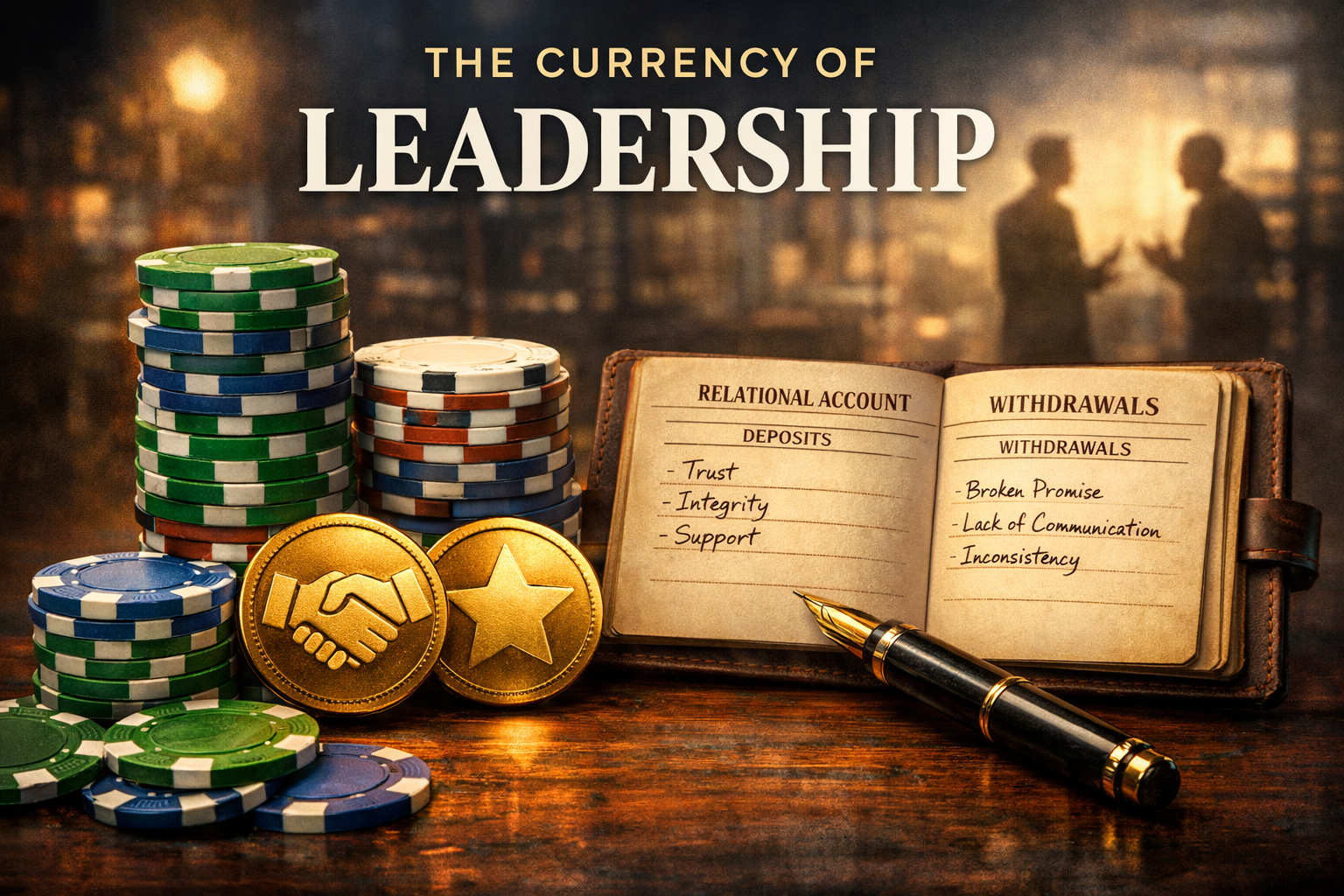
On one hand, I was grateful. Trust is not given lightly at this level. On the other, I was challenged by a couple things in that exchange.
For one, it seems I have not fully communicated the value and purpose behind the exercise. That’s on me.
Secondly, I realized I am spending valuable trust chips right now with some of the leaders I serve.
That’s a sobering thought. I don’t like it when withdrawals are made, even though I understand it’s a natural part of investing in another’s development.
Thankfully, there were enough chips in the account to cover it.
But make no mistake – it cost me something.
That interaction prompted today’s MMS and a question that I extend in your direction.
As an executive leader, are you intentionally building a reserve of relational capital that compels people to lean into hard things – not because you have authority, but because you have a bank of earned influence stored up that can be accessed when necessary?
Pay and benefits can purchase attendance.
Titles can command compliance.
Org charts and processes can enforce structure.
But none of those can produce wholehearted engagement.
The leaders who inspire people to move toward discomfort, complexity, and challenge are operating in a different currency altogether.
They are trading in trust.
Stephen M. R. Covey famously described trust as the one thing that changes everything. When trust is high, speed increases and cost decreases. When trust is low, everything slows down and becomes more expensive.
Trust is not sentimental. It is strategic. And it is built through consistent deposits over time.
If we are honest, many leaders assume strong compensation leads to loyalty. It does not. Compensation creates a contract (we’ve all heard of the trap of “the golden handcuffs”).
Trust is what creates commitment.
Are you looking for ways to add chips to the pot beyond pay and benefits, actions that build trust? Consider the following ideas:
Clarity of Purpose: Simon Sinek reminds us that people are inspired by why, not what. When leaders repeatedly connect the dots between daily tasks and meaningful purpose, they dignify the work.
When your team understands how their effort advances a mission that matters, inconvenience becomes investment.
Deposit made.
Personal Investment: John Maxwell often says that people do not care how much you know until they know how much you care. Though possibly a tired phrase for seasoned leaders, its truth is timeless. It still matters.
Do you know their aspirations? Their pressures at home? Their strengths? Their fears?
When you take time to coach, develop, and advocate for someone – especially when it does not immediately benefit you – you are adding chips into the pot.
You are communicating the fact that people matter beyond their output.
Consistency Between Words and Actions: Trust erodes quickly when promises are casual, when you don’t really mean it. Trust compounds when integrity is high.
When your “yes” consistently means yes, when your “no” means no, when expectations are clear, and when standards apply to you as much as they do to others, credibility grows.
Each commitment kept is a deposit in the trust account.
Shared Hardship: Nothing bonds teams like a leader who steps into the difficulty with them in shoulder-to-shoulder work.
Patrick Lencioni speaks often about vulnerability-based trust. When leaders admit mistakes, own blind spots, and invite feedback, they lower the relational walls that often isolate authority.
Inviting others into shared ownership of a problem and joining them in creating the solution is magnetic. It says to everyone – we are in this together.
Alignment of Values: Beyond mission statements and framed posters lies something deeper. Congruence through alignment.
Honor.
Respect.
Fairness.
Humility.
Courage.
Servant-heartedness.
Long-term thinking over short-term optics.
Stewardship over ego.
When people observe that your decisions consistently reflect these values – especially when it costs you – trust compounds.
They may not be able to articulate it. But they feel it. And they respond to it.
The real test of your cache of leadership currency is not how your team behaves when things are easy. It’s how they respond when the ask is uncomfortable.
When you request deeper preparation.
When you introduce change.
When you require accountability.
When you challenge mediocrity.
When you stretch capacity.
Do they resist but respond out of a felt sense of obligation? Or do they lean in out of respect?
One is compliance. The other is commitment. And the difference is sometimes seen in the shifting balance of your relational account.
As leaders, we are always either depositing or withdrawing.
Every conversation.
Every correction.
Every recognition.
Every decision behind closed doors.
We are shaping an invisible ledger. When people consistently experience that you are stewarding your authority for their growth and the greater good and not for selfish gain, something powerful happens.
They follow. Not because they must, but because they want to.
That is trust, the currency of leadership.
May your journey as a leader thrive on many levels – including the ones that go well beyond pay and benefits, obligation and order.
May you seek advancement in the arenas that are harder to measure, more difficult to articulate: honor, trust, alignment of purpose, shared values, personal growth, mutual respect, and meaningful contribution.
These are the arenas we seek to master as purpose-driven, God-honoring leaders. Let me know if I can help.
Blessings to you, my friends!
==========
This Week’s Resource Recommendation:
"Whole Leaders, Wild Trust: The Courageous Path to Personal, Relational, and Organizational Change"
- Rob McKenna, PhD
From Amazon: The future of leadership begins with trust―and it starts within.
In Whole Leaders, Wild Trust, leadership expert Dr. Rob McKenna redefines what it means to lead in a world fragmented by broken promises, disconnection, and low engagement. Backed by research with thousands of leaders and organizations, this book reveals how trust is built, broken, and rebuilt―and why whole leader development is the key to sustainable performance and well-being.
McKenna introduces his WiLD approach, a groundbreaking model that integrates personal growth, team dynamics, and organizational design. The result is a trust-building process that begins at the core of who we are and extends outward to reshape culture.
Inside, you'll discover:
How to diagnose the trust fractures silently undermining your people, your teams―and even your own leadership―and quickly repair them
Strategies to move your culture forward using the WiLD Trust Quadrant―from a Jungle of Trust to a Stronghold of Trust
Ways to develop whole and trusted leaders with practical tools, measurable frameworks, and conversations that build real trust from the inside out
Whether you're a seasoned executive, a parent trying to raise a future-ready leader, an emerging professional, or someone simply trying to lead well in your corner of the world―this is your roadmap to becoming a whole and trusted leader. You'll learn how to build teams that don't just function, but lead movements.
It's time to stop reacting to broken trust―and start leading from it.
MMS 26-08
I would love to send our Monday Morning Stretch directly to you via email and would consider it an honor to serve you in this way. To register, please take 30 seconds to give us permission to do so below.
