
The Fruit Tray
I was in full-time ministry when donuts and coffee were “the thing.”
And not just any donuts and coffee. We had some of the best in the region.
Occasionally there was excess that lasted into the week. Other times it was holidays, celebrations, or staff gatherings. Cakes. Cookies. Pastries. All manner of baked goods were often on the counter for the taking.
As someone who genuinely loves processed sugar, those were good times.
But somewhere along the way, my mindset – and my waistline – began to shift.
Not overnight. Not dramatically. Just slowly enough to notice that what once felt like a treat had become routine, and what once energized me now left me sluggish.
It was after that shift that I began to dream of a day when I would be responsible for the office menu.
A day when the food provided to my staff would be a bowl of beautiful, ripe, in-season, delicious, whole fruit.
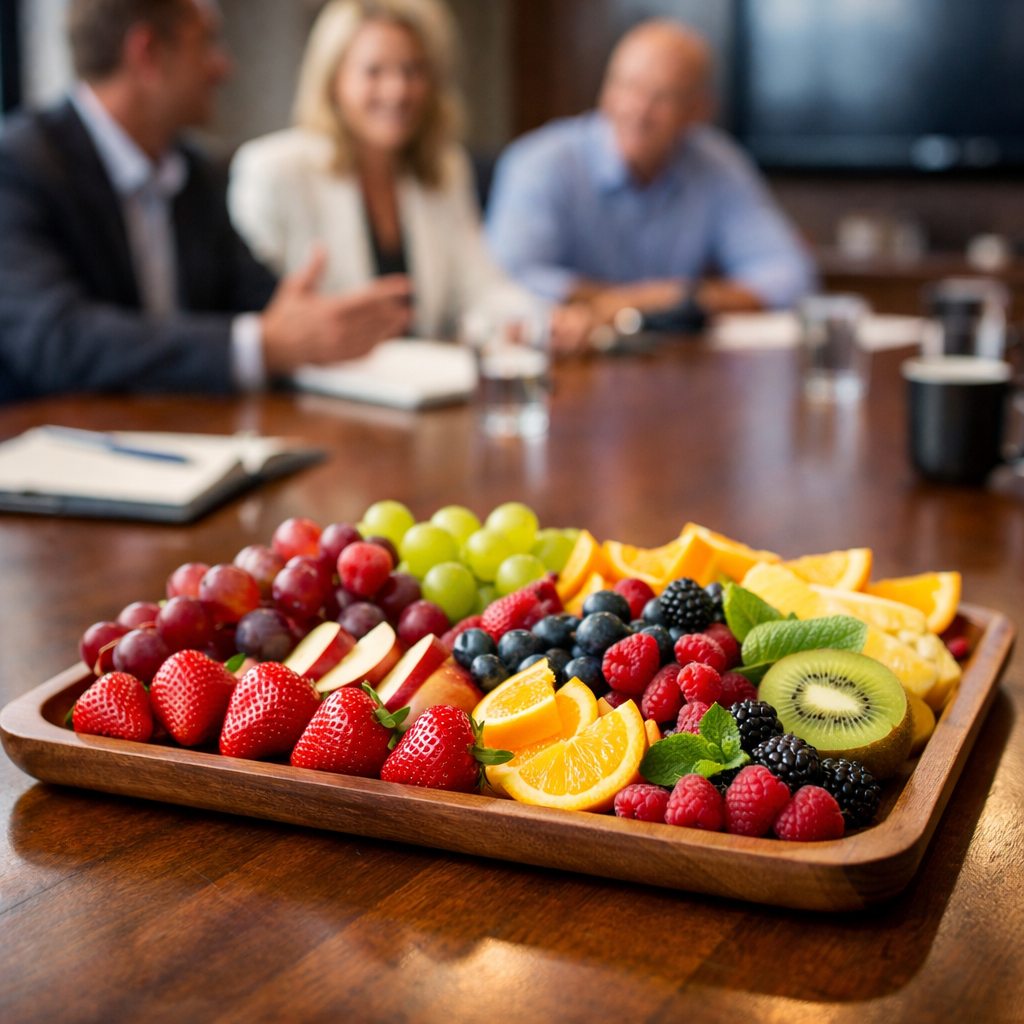
As I shared this dream with others, a couple realities surfaced quickly – both related to reduced demand.
First, it would cost more money.
Second, some of that fruit would likely go bad and end up in the trash.
Even so, the dream stuck – alongside an important question.
Why is it that when given the choice between what is healthy and what is highly processed, the majority of people will choose the latter?
The answer is simple, I guess. Processed options deliver a faster hit. They are sharper on the taste buds, more comfortably familiar, and immediately gratifying.
Whole food takes time. It requires patience. You have to “process” it yourself. It does not shout for attention.
(Hard pivot to business application..)
As a Christian business leader, you are a fruit carrier. A fruit provider.
I am not talking about snacks. I am talking about what people experience when they interact with you.
Because you, my friend, are a carrier and provider of the fruit of God’s Spirit (Galatians 5:22 – 26).
The challenge we face is that the business world at large often prefers the leadership equivalent of processed sugar.
Harsh directives.
Fear-based urgency.
Control through intimidation.
Public correction masked as accountability.
Transactional relationships built solely on leverage.
These behaviors can create movement. They can even produce short-term results. But they rarely nourish people, and they almost always carry long-term cost.
Fruit-of-the-Spirit leadership is different. It is quieter. Slower. More intentional. And yes, it is harder and can feel riskier.
But what might it look like in workplace practice? Below are a few examples for us to consider:
Love – In leadership, love shows up as genuine care for people beyond their output. It means making decisions that consider long-term human impact, not just quarterly performance.
Joy – Joy is not forced positivity. It is a steady confidence rooted in purpose. Leaders who carry joy create cultures where inevitable pressures exist without despair and in the context of hope.
Peace – Peace shows up as emotional steadiness. In volatile environments, peaceful leaders reduce chaos simply by how they show up when decisions have to be made and the air gets heavy.
Forbearance (Patience) – Patience resists reaction. It allows people room to grow, learn, and recover. It does not rush to judgment and appreciates the fact that clarity and proficiency take time and come through an evolution of thought and practice.
Kindness – Kindness in business is not weakness. It is the discipline of respect, especially when authority makes harshness not only easy but often (unfortunately) acceptable in the workplace.
Goodness – Goodness is integrity in motion. It is choosing what is right even when no one is watching and even when it costs you. Note: Goodness hurts sometimes.
Faithfulness – Faithfulness is consistency. Your people know what to expect from you. Your values do not shift with pressure or convenience. You stand by your word, and you remain faithful to the best interest of others.
Gentleness – Gentleness is strength under control. It is the ability to confront, correct, and challenge without crushing the person on the other side of the table.
Self-Control – Self-control governs tone, timing, and response. It keeps power from becoming destructive and influence from becoming ego-driven. And the greatest challenge in this space? Our tongue… (Proverbs 18:21)
Just like whole fruit, this kind of leadership costs more.
It costs time.
It costs emotional energy.
It sometimes feels inefficient.
Yes, some of it will be rejected or wasted.
Not everyone will choose it.
But those who do will be nourished by it.
I may not have an office right now where I can offer ripe, whole fruit for employees to enjoy.
But I can bring the fruit of God’s Spirit into every interaction I have with the people I serve.
In conversations.
In decisions.
In conflict.
In moments of pressure.
And so can you.
Because whether you realize it or not, every leader is setting a table. The question is: What are you serving?
Blessings to you, my friends!
==========
This Week’s Resource Recommendation:
"Humility Is the New Smart: Rethinking Human Excellence in the Smart Machine Age"
- Edward D. Hess & Katherine Ludwig
From Amazon: Your job is at risk - if not now, then soon. We are on the leading edge of a Smart Machine Age led by artificial intelligence that will be as transformative for us as the Industrial Revolution was for our ancestors. Smart machines will take over millions of jobs in manufacturing, office work, the service sector, the professions, you name it. Not only can they know more data and analyze it faster than any mere human, say Edward Hess and Katherine Ludwig, but smart machines are free of the emotional, psychological, and cultural baggage that so often mars human thinking.
So we can’t beat ’em and we can’t join ’em. To stay relevant, we have to play a different game. Hess and Ludwig offer us that game plan. We need to excel at critical, creative, and innovative thinking and at genuinely engaging with others - things machines can’t do well. The key is to change our definition of what it means to be smart. Hess and Ludwig call it being NewSmart. In this extraordinarily timely book, they offer detailed guidance for developing NewSmart attitudes and four critical behaviors that will help us adapt to the new reality.
The crucial mindset underlying NewSmart is humility - not self-effacement but an accurate self-appraisal: acknowledging you can’t have all the answers, remaining open to new ideas, and committing yourself to lifelong learning. Drawing on extensive multidisciplinary research, Hess and Ludwig emphasize that the key to success in this new era is not to be more like the machines but to excel at the best of what makes us human.
MMS 26-06
I would love to send our Monday Morning Stretch directly to you via email and would consider it an honor to serve you in this way. To register, please take 30 seconds to give us permission to do so below.
