
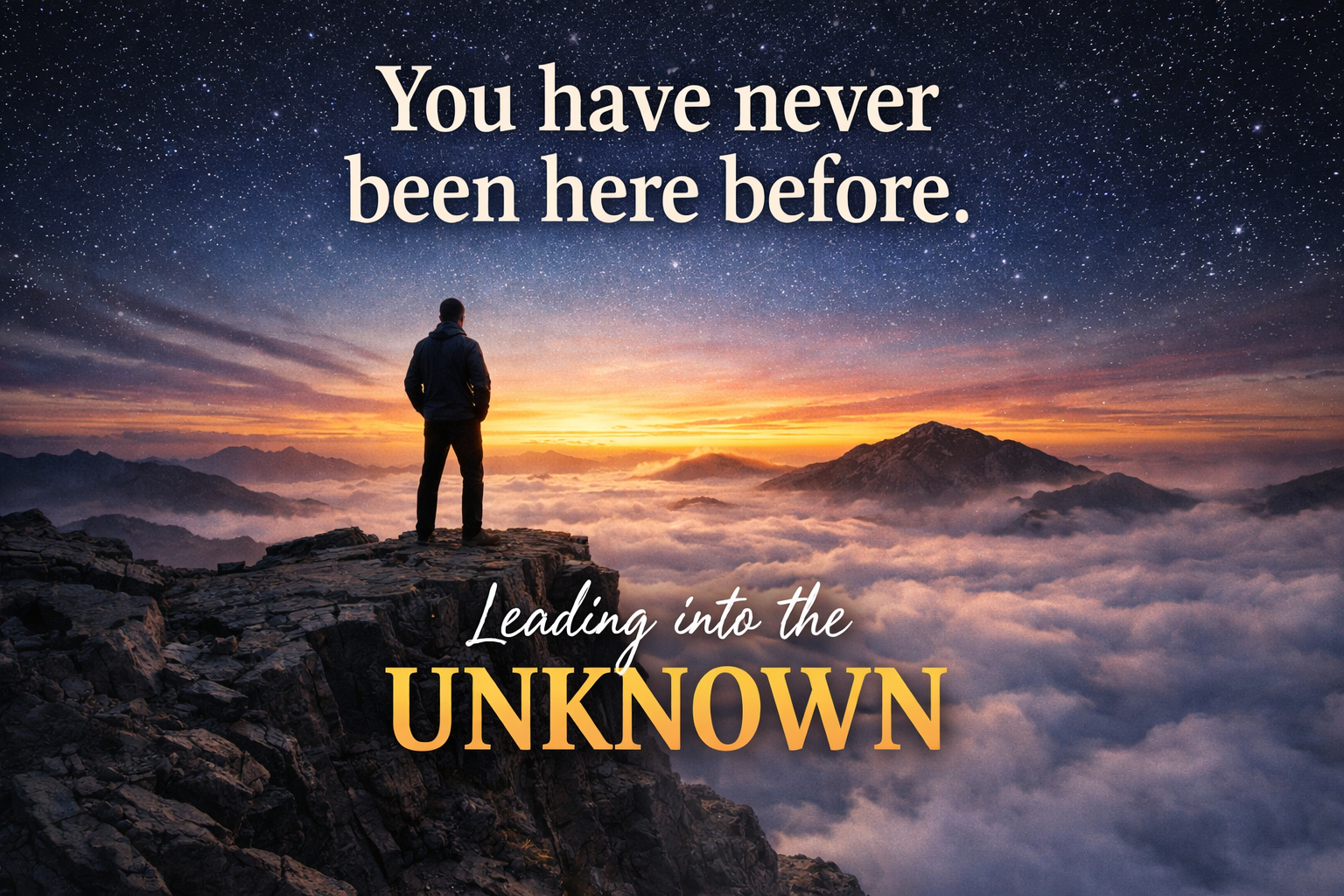
You Have Never Been Here Before
For all our progress, data, and discovery…
we are still leading into the unknown.
There is a clip making the rounds right now where Bill Maher asks a medical expert a simple but piercing question: “How much do we really know?”
The implication is unsettling. With new discoveries arriving daily, perhaps we are operating with partial understanding…maybe half?
His guest did not hesitate. He suggested it is far less than that.
Closer to ten percent.
Whether that estimate is accurate or not is beside the point. Because if we are honest, most of us already know it feels true.
Anyone who has navigated a meaningful medical issue has likely, at some point, reflected on the phrase “we are practicing medicine.” Not as a criticism as much as a recognition. Even in one of the most advanced fields in human history, there is still so much we do not fully understand.
And that reality does not stop at medicine. It extends into every domain where leaders operate. Business. Culture. Technology. Faith. Relationships. Human behavior.
We are all, in many ways, still trying to figure this thing out. Virtually every day.
When I sit with senior leaders, I am consistently struck by something that may surprise those on the outside.
The healthiest leaders are not the ones who project certainty. They are the ones who carry a quiet, grounded awareness that they are navigating something that has never been navigated before… at least not exactly like this.
They are experienced. Proven. Respected. They have led through challenges. They have made hard calls. They have seen cycles rise and fall.
They have, in many ways, “been there; done that.”
And yet…
Every leader, no matter how experienced, is navigating territory that has never been lived before.
Because no one has ever lived in the future state of our world.
Yes, someone may be a few steps ahead of you on a similar journey. That is why peer relationships matter. That is why trusted advisors are invaluable. We can learn from those who have walked similar roads.
But even then, the variables are never identical. (As we say in basketball officiating, "Those were similar plays, but they weren't the same play.")
The pace of technological change is different.
The financial markets are in a separate cycle.
The geopolitical landscape has shifted.
The cultural moment has evolved.
The information available today was not available yesterday.
What someone else experienced was real… but it was not THIS. And it never will be again.
This is where many leaders feel the tension.
There is an unspoken expectation at the top that you are supposed…
To know.
To have the answer.
To see around corners.
To provide clarity in the midst of complexity.
And while wisdom, experience, and discernment absolutely matter, certainty is not part of the job description.
Hint: It never was.
In fact, the attempt to manufacture certainty in an uncertain world often leads to poor decisions, rigid thinking, and unnecessary risk.
The better path is not pretending to know. It is learning how to lead well when you don’t.
That calls for a different posture. Among other things:
It requires a sense of adventure.
Not recklessness, but a willingness to step forward without having every variable solved. To see leadership not just as a burden to carry, but as a frontier to explore.
It requires a commitment to lifelong learning.
If the landscape is constantly changing, the leader must evolve rapidly. Curiosity becomes a strategic advantage. Humility becomes a growth engine.
It requires a healthy relationship with risk.
Not avoiding it and not blindly chasing it. But understanding that progress and uncertainty are permanently linked.
It requires community.
No one was designed to navigate uncharted territory alone. The right voices around you do not eliminate uncertainty, but they do sharpen perspective, challenge assumptions, inspire confidence, and steady your footing.
Plans fail for lack of counsel, but with many advisers they succeed. – Proverbs 15:22
It requires trust in something greater than yourself.
Because if the future is unknowable, then control is, at best, an illusion.
Trust in the Lord with all your heart and lean not on your own understanding; in all your ways submit to him, and he will make your paths straight. – Proverbs 3:5 – 6
You have never been where you are going tomorrow. No one has.
That is not a liability. It is the reality of leadership. And for those willing to embrace it, it becomes something more than a challenge to endure.
It becomes an invitation to lead with courage, to grow with intention, to walk forward with others, and to trust that even in the unknown, you are not alone.
Blessings to you, my friends!
==========
This Week’s Resource Recommendation:
"Thinking in Bets: Making Smarter Decisions When You Don't Have All the Facts"
- Annie Duke
From Amazon: In Super Bowl XLIX, Seahawks coach Pete Carroll made one of the most controversial calls in football history: With 26 seconds remaining and trailing by four at the Patriots' one-yard line, he called for a pass instead of a hand off to his star running back. The pass was intercepted and the Seahawks lost. Critics called it the dumbest play in history. But was the call really that bad? Or did Carroll actually make a great move that was ruined by bad luck?
Even the best decision doesn't yield the best outcome every time. There's always an element of luck that you can't control, and there is always information that is hidden from view. So the key to long-term success (and avoiding worrying yourself to death) is to think in bets: How sure am I? What are the possible ways things could turn out? What decision has the highest odds of success? Did I land in the unlucky 10% on the strategy that works 90% of the time? Or is my success attributable to dumb luck rather than great decision making?
Annie Duke, a former World Series of Poker champion turned business consultant, draws on examples from business, sports, politics, and (of course) poker to share tools anyone can use to embrace uncertainty and make better decisions. For most people, it's difficult to say "I'm not sure" in a world that values and, even, rewards the appearance of certainty. But professional poker players are comfortable with the fact that great decisions don't always lead to great outcomes and bad decisions don't always lead to bad outcomes.
By shifting your thinking from a need for certainty to a goal of accurately assessing what you know and what you don't, you'll be less vulnerable to reactive emotions, knee-jerk biases, and destructive habits in your decision making. You'll become more confident, calm, compassionate and successful in the long run.
MMS 26-12
I would love to send our Monday Morning Stretch directly to you via email and would consider it an honor to serve you in this way. To register, please take 30 seconds to give us permission to do so below.
