
A Commercial Success
Christian leaders tend to speak comfortably about generosity. We encourage it. We celebrate it. We build language, culture, and reputation around it.
And rightly so.
But when commerce enters the conversation, especially profit, pricing, ownership, or control, the tone often shifts.
Tension creeps in. Motives get questioned. Assumptions are many.
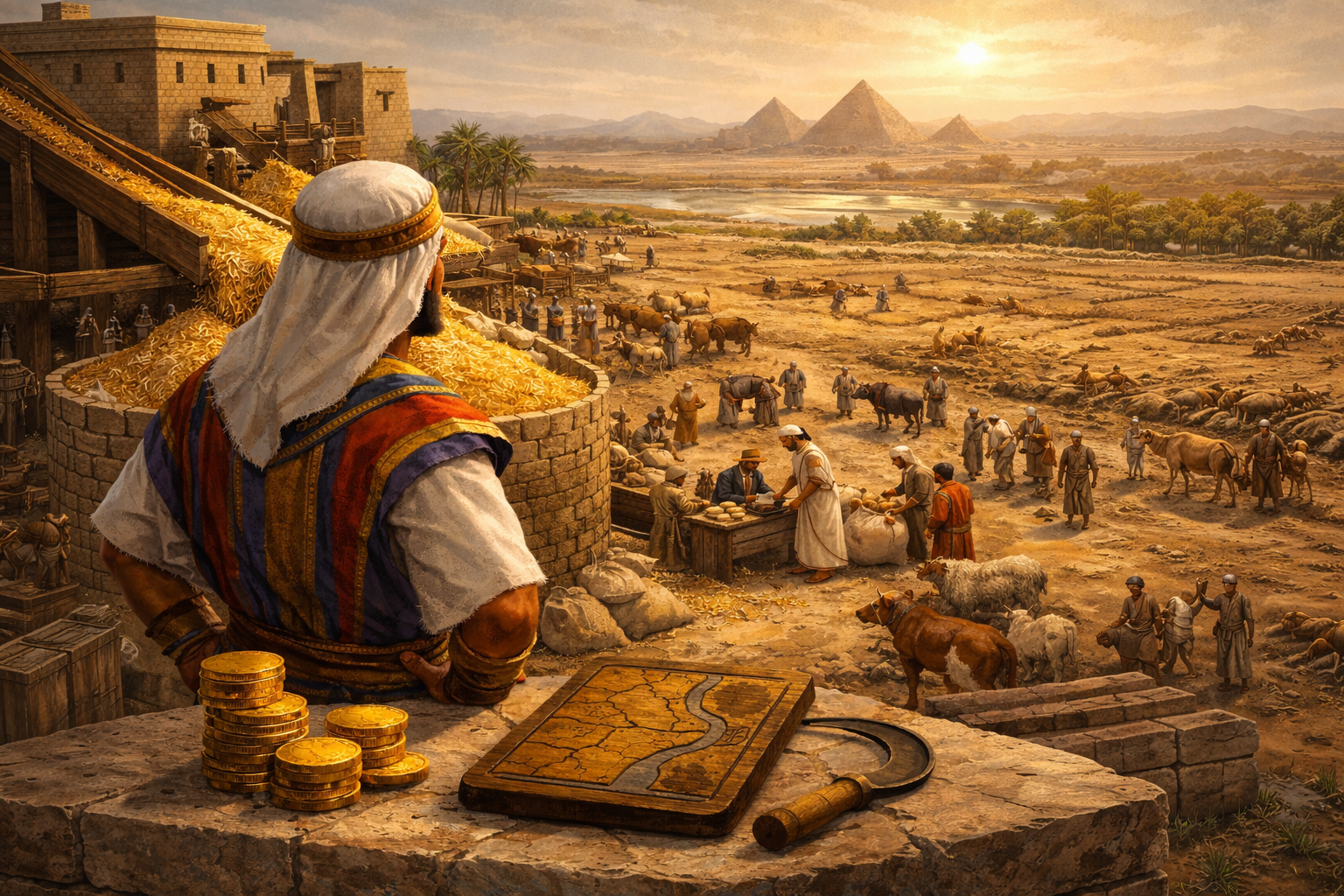
I recently wrapped up the book of Genesis in my morning Bible reading. This time around the story of Joseph hit a little differently.
What leapt out to me was a layer of that story that read like a leadership case study built almost entirely around economic strategy.
You’ll recall Pharaoh had two troubling dreams, and God gave Joseph their insightful interpretation: Seven years of abundance were coming, followed by seven years of severe famine (Genesis 41:25 – 31).
What I found fascinating, even beyond Pharaoh’s transfer of ultimate control to Joseph (the former dungeon-dweller), was the recommended strategy.
Joseph did not recommend prayer. He did not suggest redistribution. He proposed a comprehensive long-term plan.
He advised Pharaoh to appoint overseers, collect a fifth of the harvest during the years of abundance, store grain strategically, and prepare for the coming crisis (Genesis 41:33 – 36).
Forecasting.
Storage.
Logistics.
Governance.
Pharaoh saw the wisdom in his proposal and placed Joseph in full operational control of the nation's economy.
Then the famine came.
When the people ran out of food, Joseph sold grain to them.
When they ran out of money, they traded livestock.
When the livestock was gone, they traded land and labor.
By the end of the famine, Pharaoh controlled the money (all of it), the livestock (all of it), the land, and the labor force (Genesis 47:13 – 21).
Even so, the people said something remarkable: “You have saved our lives… May we find favor in the eyes of our lord; we will be in bondage to Pharaoh.” (Genesis 47:25)
Scripture does not frame Joseph or his plan as corrupt or cruel. It presents the story as wisdom. The system he designed preserved life. The people survived. National stability emerged from chaos.
This is where some may begin to feel uneasy.
Joseph did not give the grain away.
He did not dissolve Pharaoh’s ownership of virtually everything.
He did not eliminate hierarchy.
He implemented a marketplace system that required value to be exchanged for sustenance.
And God honored it.
This does not diminish the imperative of benevolence or generosity. For me, anyway, it adds a base layer to the conversation that includes wisdom and commerce.
Joseph’s responsibility to the nation was not emotional relief. It was preservation. His calling required discipline, foresight, and an unflinching understanding of the scarcity that was about to come upon them.
I believe this story invites honest reflection.
Do we ever wrestle with the thought of faithfulness and commercial discipline being in conflict?
Do we confuse compassion with the absence of sustainable structure?
Do we default to generosity language when the real need is operational leadership?
Do we understand and appreciate the difficulty of making broad-stroke decisions that are necessary for (family, organizational, societal, national) survival?
Joseph reminds us that commerce, when guided by wisdom and integrity, can be a tool of preservation, even when some may interpret it as exploitation.
Scripture does not apologize for Joseph’s strategy. It documents it. In detail. Without apology or moral judgement.
That alone should stretch us.
Because if God was willing to use forecasting, taxation, pricing, and centralized control to preserve life then, perhaps the marketplace is not the enemy many sometimes fear it to be.
Perhaps it is one of the arenas where faithful, purpose driven, God-honoring leadership matters more than we realize.
Something to think about, anyway…
Blessings to you, my friends!
==========
This Week’s Resource Recommendation:
"The Wisdom Of Finance: Discovering Humanity in the World of Risk and Return"
- Mihir Desai
From Amazon: In 1688, essayist Josef de la Vega described finance as both “the fairest and most deceitful business . . . the noblest and the most infamous in the world, the finest and most vulgar on earth.”
The characterization of finance as deceitful, infamous, and vulgar still rings true today – particularly in the wake of the 2008 financial crisis. But, what happened to the fairest, noblest, and finest profession that de la Vega saw?
De la Vega hit on an essential truth that has been forgotten: finance can be just as principled, life-affirming, and worthy as it can be fraught with questionable practices. Today, finance is shrouded in mystery for outsiders, while many insiders are uneasy with the disrepute of their profession. How can finance become more accessible and also recover its nobility?
Harvard Business School professor Mihir Desai, in his “last lecture” to the graduating Harvard MBA class of 2015, took up the cause of restoring humanity to finance. With incisive wit and irony, his lecture drew upon a rich knowledge of literature, film, history, and philosophy to explain the inner workings of finance in a manner that has never been seen before.
This book captures Desai’s lucid exploration of the ideas of finance as seen through the unusual prism of the humanities. Through this novel, creative approach, Desai shows that outsiders can access the underlying ideas easily and insiders can reacquaint themselves with the core humanity of their profession.
The mix of finance and the humanities creates unusual pairings: Jane Austen and Anthony Trollope are guides to risk management; Jeff Koons becomes an advocate of leverage; and Mel Brooks’s The Producers teaches us about fiduciary responsibility. In Desai’s vision, the principles of finance also provide answers to critical questions in our lives. Among many surprising parallels, bankruptcy teaches us how to react to failure, the lessons of mergers apply to marriages, and the Capital Asset Pricing Model demonstrates the true value of relationships.
THE WISDOM OF FINANCE is a wholly unique book, offering a refreshing new perspective on one of the world’s most complex and misunderstood professions.
MMS 26-04
I would love to send our Monday Morning Stretch directly to you via email and would consider it an honor to serve you in this way. To register, please take 30 seconds to give us permission to do so below.
