
When Chaos Hits
The decision took less than two seconds. The preparation behind that decision has taken years.
Three seventeen-year-old young men were aggressively pursuing a loose ball. My eyes were darting across about fifteen degrees of viewing angle scanning for a tie-up, illegal contact, or unnecessary roughness.
At the same time, a coach was directly behind me yelling for a time out. In order to grant that time out, however, I needed visual proof of player control of the ball.
The entire sequence lasted maybe three seconds. Tops.
In that compressed moment, I processed what I saw: no illegal contact, no clear single player control, and two opponents with hands on the ball.
I blew my whistle, indicated a clock stop signal, ruled a held ball, and went to the alternating possession arrow.
The coach was upset. He had “been calling for a time out the whole time!”
But the game had already moved on. There was no time to explain everything I had processed in those three seconds. All I said was, “Four hands on the ball, coach. I had four hands on the ball.”
And off I went to the other side of the gym.
Though maybe a stretch of an illustration, that moment is representative of the speed, myriad factors, and onslaught of decisions executive leaders face every day.
Most leadership decisions are not made in calm, controlled environments with time to deliberate, explain, and justify. They are made in compressed moments filled with noise, pressure, incomplete information, competing demands, and people who want an answer now.
If we’re being honest, the full decision-making process is often difficult to articulate after the fact, even when the decision is sound.
In my case, it took a good bit of reflection just to describe the chaos of those three seconds from a game that had thirty-two minutes (1,920 seconds) of playing time.
Even then, I didn’t capture everything. For instance, I didn’t mention that it was a Friday night at the end of a long, full week that included significant personal and professional challenges.
Fatigue matters. Context matters. Experience matters.
This is an important realization for senior leaders.
At the pace of life and leadership most executives are running, you cannot expect to “rise to the occasion” over and over again. Human beings are not built for that. It’s not sustainable.
You might get away with reaching beyond your skis once in a while. But if that becomes your operating model, failure is not a possibility. It is a certainty.
That is why a regular rhythm of training and development matters, especially for senior leaders.
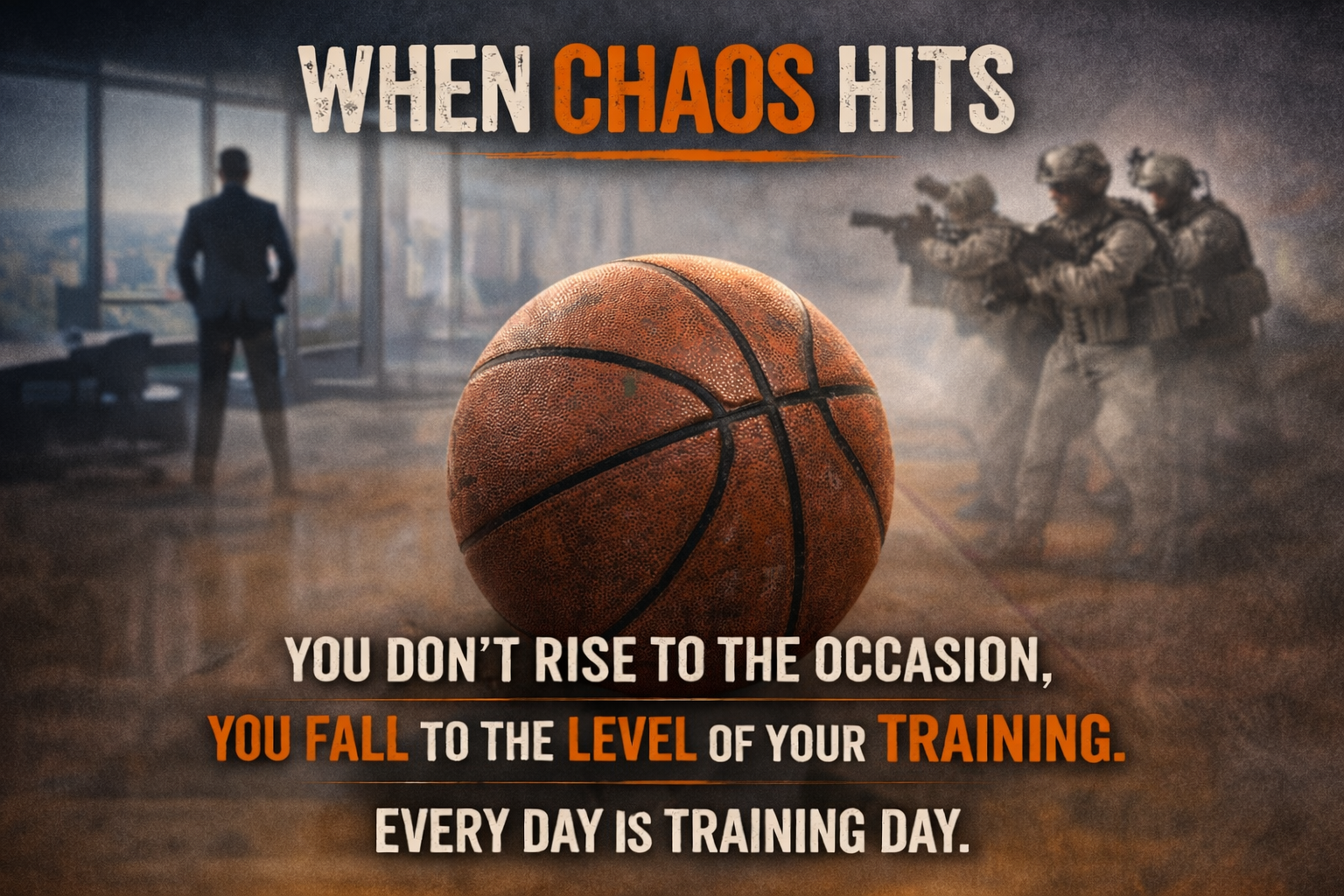
Navy SEALs training hits this one hard. They know when chaos hits, we do not rise to the occasion. We fall to our level of training.
In that split second on the basketball court, I did not invent a response. I relied on my training, my rules knowledge, the repetitions I had logged in similar situations, the mental rehearsals I had run in my head, the video study, and the coaching I’ve received from seasoned veterans.
This is why we don’t put rookie officials on varsity contests. It’s why we don’t put recent college graduates at the top of organizations. It’s why business owners act so quickly on strong convictions after twenty-five years in the trenches, even if they cannot always perfectly articulate the logic behind every decision…
…decisions that are made dozens of times a day, often under pressure, without applause, and without the luxury of time for an explanation.
As an aside, this is why Convene Teams gather every month – to train and develop alongside one another. Not to chase information, but to build formation. Not to react to chaos, but to prepare for it. To do what they can to better prepare them for the inevitable, challenging decisions that lay ahead.
When the pressure of business, life, and faith hits multiple times a day, leaders who have trained for it respond differently. They are calmer. Clearer. More grounded. More confident in what they see and what they decide.
It’s a response that does not happen accidentally. It’s the result of awareness, intentionality, and training.
Remember, any day could be game day, but…
Every Day Is Training Day!
Blessings to you, my friends!
==========
This Week’s Resource Recommendation:
"The Practice of Adaptive Leadership: Tools and Tactics for Changing Your Organization and the World"
- Ronald A. Heifetz, Marty Linsky, and Alexander Grashow
From Amazon: When change requires you to challenge people's familiar reality, it can be difficult, dangerous work. Whatever the context--whether in the private or the public sector--many will feel threatened as you push through major changes. But as a leader, you need to find a way to make it work.
Ron Heifetz first defined this problem with his distinctive theory of adaptive leadership in Leadership Without Easy Answers. In a second book, Leadership on the Line, Heifetz and coauthor Marty Linsky highlighted the individual and organizational dangers of leading through deep change in business, politics, and community life. Now, Heifetz, Linsky, and coauthor Alexander Grashow are taking the next step: The Practice of Adaptive Leadership is a hands-on, practical guide containing stories, tools, diagrams, cases, and worksheets to help you develop your skills as an adaptive leader, able to take people outside their comfort zones and assess and address the toughest challenges.
The authors have decades of experience helping people and organizations create cultures of adaptive leadership. In today's rapidly changing world, The Practice of Adaptive Leadership can be your handbook to meeting the demands of leadership in the midst of complexity.
MMS 26-03
I would love to send our Monday Morning Stretch directly to you via email and would consider it an honor to serve you in this way. To register, please take 30 seconds to give us permission to do so below.
