
The Fairness Trap
The moment a leader promises fairness, they step into a minefield of expectations they cannot fully control.
Fairness is not a fixed point. It is a constantly moving target shaped by bias, perspective, and self-interest.
Unfortunately, fairness feels like a reasonable expectation in leadership.
Employees expect it.
Customers demand it.
Vendors measure it.
Boards assume it.
And leaders are right to care deeply about being as fair as possible in their dealings with others.
The challenge is the fact that everyone brings their own definition of “fair” into the conversation. And almost without exception, that definition leans in the direction of their personal biases.
That reality makes fairness, at its core, a leadership trap.
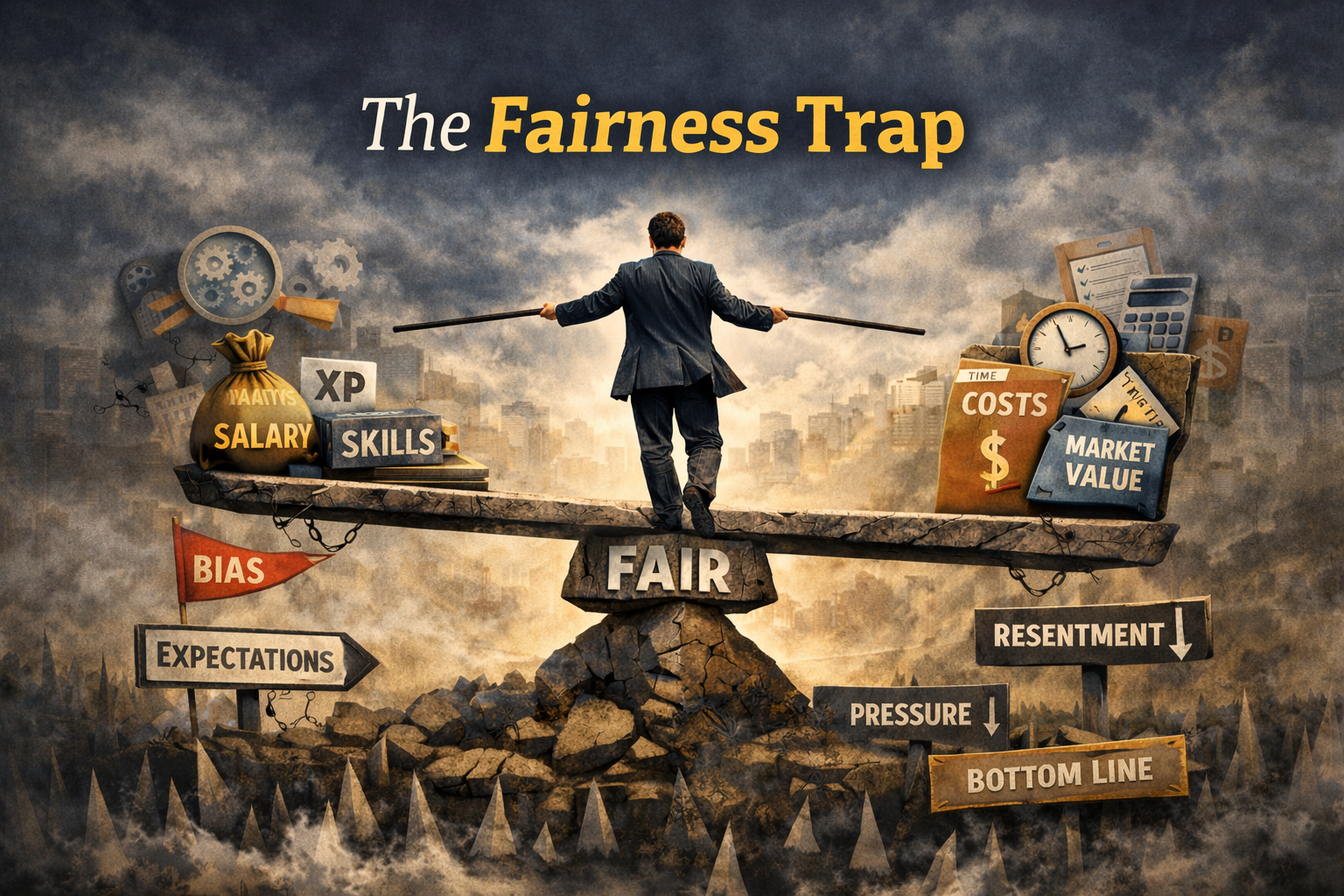
What one person experiences as equitable, another experiences as unjust. Not necessarily because that person is being dishonest, but because perspective is never neutral.
Personal history, unmet expectations, comparison, ambition, fear, and insecurity all quietly shape how fairness is interpreted.
Leaders are not immune to this either.
We like to believe we are perfectly objective. We are not.
We like to believe we are stoically impartial. We are influenced.
We like to believe fairness is accurately measurable. Rarely, if ever.
Salary Administration is my favorite example of this leadership tension.
It’s where fairness goes to die, and I struggle with just about every facet of it. Few leadership responsibilities expose the illusion of fairness more clearly than compensation.
Salary decisions require leaders to weigh a staggering number of variables:
Education
Training
Experience
Effort
Skills
Abilities
Proven value
Future potential
IQ
EQ
Leadership capacity
Market rates
Internal equity
Past compensation
Benefits expectations
Organizational margins
And more…
Every factor matters. And everyone involved in the process assigns different weight to each one.
So when the question comes, “Is this offer fair?” the honest response is often, “To whom?”
A leader may believe they are being generous.
An employee may feel undervalued.
A peer may feel overlooked.
A customer may feel the downstream cost.
The organization may feel the long-term pressure.
Even well-intentioned generosity has limits. Paying far above market may feel noble, but it raises legitimate questions about sustainability, stewardship, and responsibility to the broader system.
Fairness does not exist in a vacuum. It creates ripples felt by everyone connected to the decision.
Fairness becomes a trap when leaders treat it as a fixed destination rather than a tension to steward, when they promise outcomes instead of principles, when they prioritize appeasement over clarity, when they chase universal approval rather than faithful responsibility.
The apostle Paul grounds us as leaders with this reminder:
So then, each of us will give an account of ourselves to God. – Romans 14:12
Short and sweet, but it is a sobering leadership lens.
You and I are not accountable to everyone’s definition of fair.
We are accountable to steward what has been entrusted to us with wisdom, integrity, and courage.
Mature leadership does not abandon fairness. It reframes it.
Healthy leaders shift the question from, “Does everyone feel this is fair?” to, “Was this decision made with clarity, consistency, humility, and discernment?”
Fairness redeemed looks less like perfect balance and more like:
Transparent decision-making
Clear standards applied consistently
Willingness to explain the why
Openness to feedback without surrendering conviction
Healthy deference toward treating the others well
Grace for those disappointed by outcomes
Wisdom, not fairness alone, is the higher calling.
The best leaders I know hold fairness with open hands. They acknowledge the complexity rather than oversimplify it. They accept that disappointment is inevitable. They pursue what is right, not what is easiest.
They lead with grace instead of defensiveness, acceptance instead of denial, discernment instead of rigidity, and humility instead of certainty.
Fairness is not something we solve once. It is something we have to steward repeatedly.
And when leaders stop trying so hard to win the fairness game, they often find they gain something far more valuable: Trust.
And trust, my fellow traveler, is the very core of healthy leadership.
If this tension resonates with you and/or you are navigating similar leadership dilemmas, this is exactly the kind of conversation we facilitate inside Convene peer advisory teams and executive coaching engagements. Let me know if you would like to learn more.
Blessings to you, my friends!
==========
This Week’s Resource Recommendation:
"The Hard Thing About Hard Things: Building a Business When There Are No Easy Answers —Straight Talk on the Challenges of Entrepreneurship"
- Ben Horowitz
From Amazon: Ben Horowitz, cofounder of Andreessen Horowitz and one of Silicon Valley's most respected and experienced entrepreneurs, offers essential advice on building and running a startup—practical wisdom for managing the toughest problems business school doesn’t cover, based on his popular ben’s blog.
While many people talk about how great it is to start a business, very few are honest about how difficult it is to run one. Ben Horowitz analyzes the problems that confront leaders every day, sharing the insights he’s gained developing, managing, selling, buying, investing in, and supervising technology companies. A lifelong rap fanatic, he amplifies business lessons with lyrics from his favorite songs, telling it straight about everything from firing friends to poaching competitors, cultivating and sustaining a CEO mentality to knowing the right time to cash in.
Filled with his trademark humor and straight talk, The Hard Thing About Hard Things is invaluable for veteran entrepreneurs as well as those aspiring to their own new ventures, drawing from Horowitz's personal and often humbling experiences.
MMS 26-02
I would love to send our Monday Morning Stretch directly to you via email and would consider it an honor to serve you in this way. To register, please take 30 seconds to give us permission to do so below.
