
We have a serious problem in our household. We have a “flat surface” problem.
Virtually every inactive flat surface in our home seems to be laden with something that belongs somewhere else.
Stacks of paper over here. Books over there. Laundry to be folded. A bag by the door. A box on a chair.
We are not hoarders. Our home is not unclean. It’s just not always tidy or ordered because every available flat surface eventually becomes a temporary landing zone. At least, we call it “temporary.”
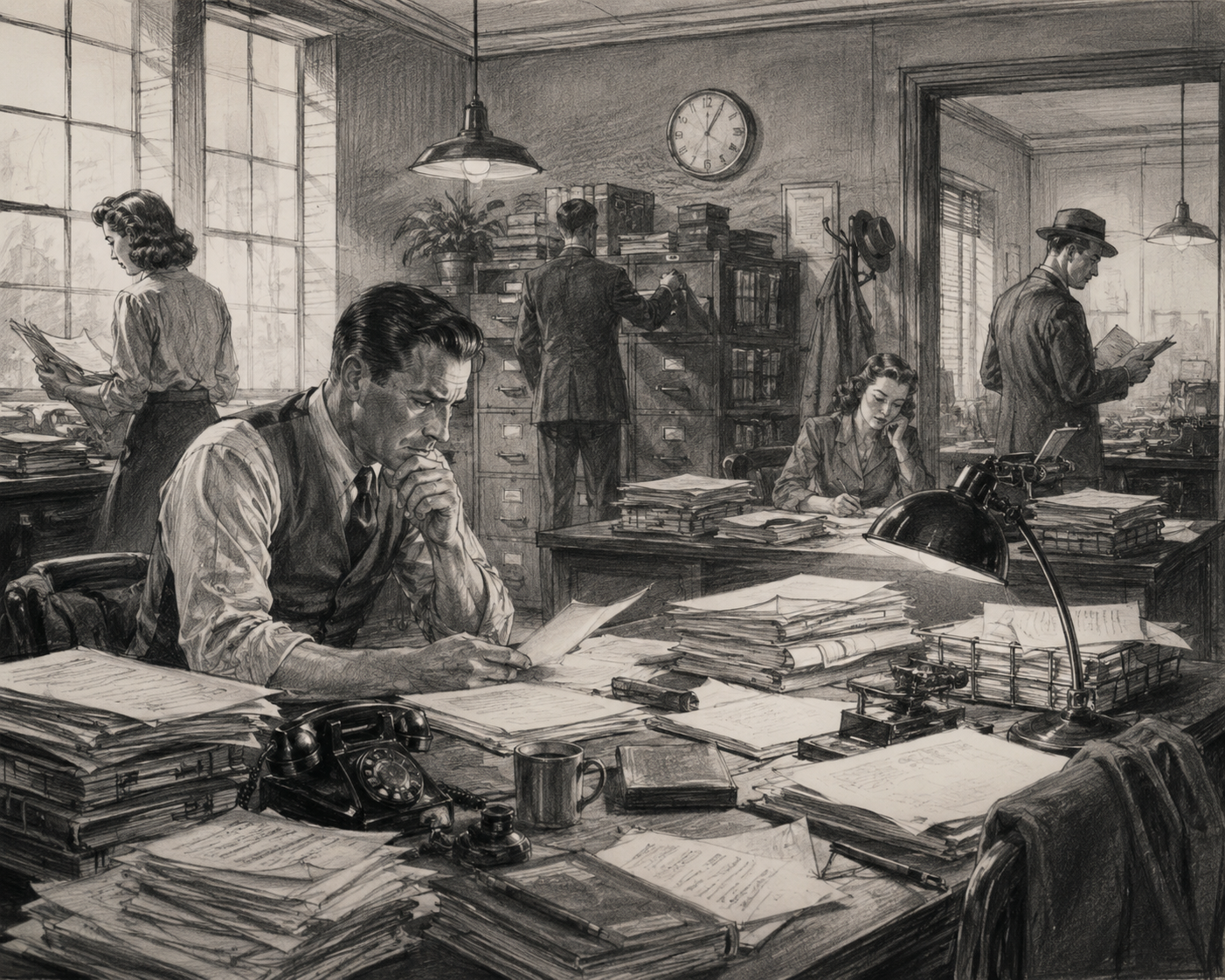
An item gets set down because we don’t have time to deal with it. Then another item joins it. Before long, the table is unable to serve its designed purpose.
It has become a holding area for incomplete decisions.
Unfortunately, it all adds to the mental clutter (burden) of life. Nothing on the surface may be urgent, but each item quietly demands something of us.
Deal with me. Put me away. Make a decision. Don’t forget about me…
News Flash: There are “flat surfaces” in our businesses, too.
The unfinished work in your organization may not be urgent enough to demand immediate attention, but it is still consuming mental capacity.
The incomplete project. The idea that is continually discussed but never developed. The process that exists only in someone’s head. The wall that needs to be painted. The broken office chair everyone has learned to work around. The role that needs to be eliminated, redefined, or added.
The decision that has been delayed so many times that people have stopped expecting it to be made.
These are the flat surfaces of organizational life.
None of them may bring the business to a halt today. But they still take up space. They consume attention, create friction, and add to the mental burden of the organization.
Leaders often assume this is a discipline problem. Sometimes it is, but there are at least three reasons for this malady:
Low Capacity
Insufficient Systems
Lack of Discipline (to sufficient Systems)
Sometimes things accumulate simply because we don’t know where to put them. We simply don't have room (Capacity), or the item doesn’t have a designed place (System).
We either simply don't have room, or our household system isn’t designed to store it, process it, or retrieve it easily. And creating the right place would require more time and energy than we have in the moment, so we leave it somewhere visible.
The other reason we leave things on flat surfaces is to keep said item top of mind. We are afraid that if we put it away, we’ll lose it, forget we had it, or not be able to retrieve it in the future when we need it.
That’s more than a storage problem. It’s a trust problem.
We don’t trust the system to bring the item back to us when we need it.
Businesses do the same thing.
Projects remain on meeting agendas because there is no trusted project management system.
Ideas live in inboxes because there is no reliable place to capture and evaluate them.
Leaders hold details in their heads because they do not trust the organization to remember them.
Documents stay on personal computers because there is no common repository that everyone understands.
Eventually, leaders become the storage system. They become the project tracker, the filing cabinet, and the institutional memory.
That may work for a season, but it (obviously) doesn’t scale.
Healthy organizations create clear homes for things.
Every project has an owner. Every recurring process has documentation. Every important idea has a place to be captured and evaluated. Every decision has a next step. Every role has a purpose.
That doesn’t mean everything should be preserved. Sometimes the item doesn’t need a better home. It needs to be put in the trash bin.
Not every idea deserves development. Not every project should be completed. Not every process should continue. Not every unresolved issue deserves another meeting.
Some unfinished business remains unfinished because no one has been willing to say, “We’re not doing this anymore.”
That decision falls in the lap of leadership as well.
For every item lying on the flat surfaces of your business, there are at least three possible decisions:
Give it a permanent home.
Create a dependable process.
Let it go.
What doesn’t work is allowing it to remain indefinitely in organizational limbo.
Look around your business.
What incomplete project continues to occupy mental space
What process needs to be documented?
What decision needs to be made?
What physical issue has become an accepted inconvenience?
What idea needs either an owner or a funeral?
Do you have a reliable, repeatable practice of cleaning up the “flat surfaces” on a regular basis?
Perhaps it’s time to clean house. Not because a tidy organization looks better (though it does), but…
Because order creates capacity, clear systems reduce friction, and closed loops free mental energy.
Every flat surface eventually reveals the quality of the system behind it. It is rarely just about the availability of the countertop.
And in leadership, it is rarely just about the unfinished project. It is about the design and culture of the organization.
Blessings to you, my friends!
==========
This Week’s Resource Recommendation:
"The Goal: 40th Anniversary Edition: A Process of Ongoing Improvement”
- Eliyahu M. Goldratt & Jeff Cox
From Amazon: Written in a fast-paced thriller style, The Goal is the gripping novel which is transforming management thinking throughout the Western world. The author has been described by Fortune as a 'guru to industry' and by Businessweek as a 'genius'. It is a book to recommend to your friends in industry - even to your bosses - but not to your competitors.
Alex Rogo is a harried plant manager working ever more desperately to try and improve performance. His factory is rapidly heading for disaster. So is his marriage. He has ninety days to save his plant - or it will be closed by corporate HQ, with hundreds of job losses. It takes a chance meeting with a colleague from student days - Jonah - to help him break out of conventional ways of thinking to see what needs to be done.
The story of Alex's fight to save his plant is more than compulsive reading. It contains a serious message for all managers in industry and explains the ideas which underline the Theory of Constraints (TOC) developed by Eli Goldratt. Eliyahu M. Goldratt is an internationally recognized leader in the development of new business management concepts and systems, and acts as an educator to many of the world's corporations. The 20th anniversary edition includes a series of detailed case study interviews by David Whitford, Editor at Large, Fortune Small Business, which explore how organizations around the world have been transformed by Eli Goldratt's ideas.
MMS 26-29
I would love to send our Monday Morning Stretch directly to you via email and would consider it an honor to serve you in this way. To register, please take 30 seconds to give us permission to do so below.
