
I knew how to use a microphone. At least, I thought I did. But it took less than five seconds for me to destroy thousands of dollars’ worth of professional audio equipment.
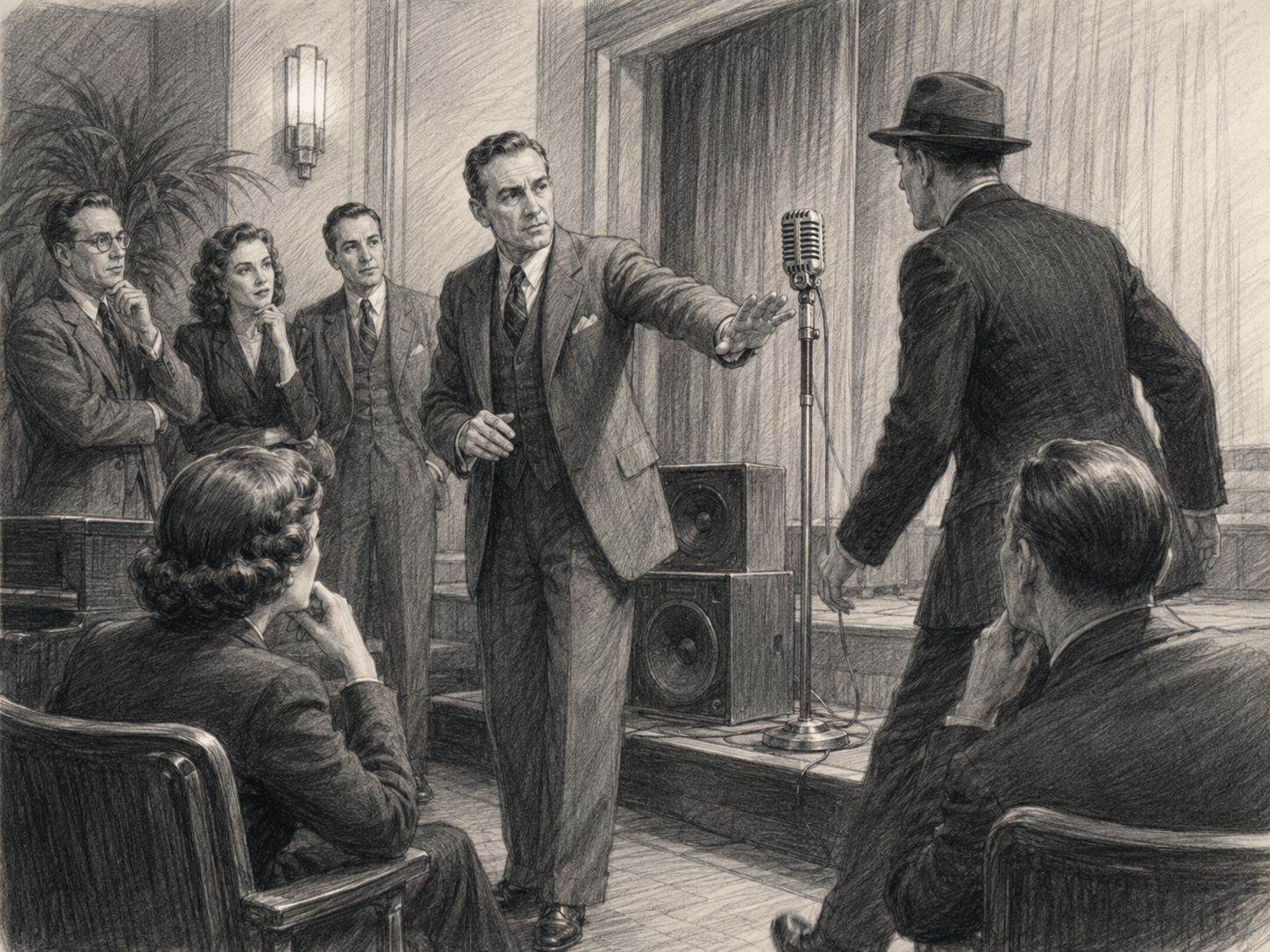
In the mid-1990s, our church hosted a concert featuring a well-known Christian singer-songwriter. A local Christian radio station helped sponsor the event, and one of its DJs brought in a professional-grade sound system for the evening.
This wasn’t a small church setup. He arrived with a large truck, premium equipment, and everything necessary to support a major recording artist.
As part of the worship team, I was asked to help lead a few songs before the concert began. We completed our sound check, and the DJ stepped away from the soundboard for a brief conversation.
I walked off the stage holding a live microphone, and within seconds, the mic caught the speakers, created a feedback loop, and destroyed several speaker cabinets.
My memory of the exact numbers may off, but I believe there were four cabinets valued at roughly $2,000 each (in 1995 dollars!).
And just like that, they were no more.
The DJ, though understandably upset, graciously took responsibility because he had stepped away from the board. Thankfully, he had backup speakers in his truck, and the concert went on without further trouble.
But I felt terrible.
What bothered me most was that I wasn’t inexperienced. I knew not to stand directly in front of a speaker with a live mic. I understood the basic principles. What I didn’t understand was that there was a particular area in front of center stage where the microphone could enter the speakers’ sound field. I had no idea that danger zone existed.
Nearly thirty years later, that lesson returned in a very personal way.
I recently purchased a much smaller (but still high-quality) PA system and offered to let my family use it during a reunion.
The instructions were simple:
Do not stand in front of the speakers.
Do not pass a live microphone in front of the speakers.
Hold the microphone close to your mouth and allow the person running the sound system to adjust the volume.
That was nearly everything they needed to know. Basic. Clear. Nothing complicated.
And yet…I practically had to stand next to the emcee encouraging them to put the mic back up to their mouth, preventing them from walking in front of the speakers, and freaking out a little as they passed a live microphone directly across the audio field more than once!
These were not careless children. They were intelligent, educated, reasonable adults. They had heard the instructions.
They simply weren’t well versed and didn’t understand the risk.
They had never heard a feedback loop explode through a sound system. They had never watched thousands of dollars of equipment disappear in seconds. They had never felt the pain that had stayed with me for almost thirty years.
What was obvious to me was not obvious to them.
There is an important leadership lesson here for us to consider.
Some of the most expensive mistakes in an organization are made by intelligent, capable people who simply didn’t know what everyone assumed they knew.
Leaders often mistake intelligence for competence, experience for familiarity, and common sense for shared understanding. Those assumptions can become very expensive.
We say things like:
“Everyone should know that.”
“That’s just common sense.”
“They’re experienced enough to figure it out.”
“They’ve been here long enough.”
But intelligence doesn’t create task-specific knowledge, and education doesn’t replace training. Experience in one environment doesn’t guarantee competence in another.
There are few instructions more basic than, “Don’t walk in front of a speaker with a live microphone.”
But let’s be clear: Basic does not mean obvious, especially to someone who has never experienced the consequences.
In our organizations, we entrust people with more than equipment. We entrust them with clients/customers, financial resources, confidential information, operational systems, valuable IP, organizational credibility, and the livelihoods of everyone connected to the enterprise.
Mistakes will happen. Even capable, trained, conscientious people will occasionally get something wrong. That’s inevitable in our business, life, and faith journeys.
Leaders shouldn’t create cultures where people are afraid to act because every error is treated as a character flaw. At the same time, we should resist the temptation to label every mistake as unavoidable.
Some mistakes are the price of learning. Others are the price of assuming. And a healthy organization knows the difference.
Clear processes matter.
Training matters.
Repetition matters.
Supervision matters.
Follow-up matters.
Reasonable accountability matters.
A process has not been communicated simply because it was mentioned once. An employee has not been trained just because someone explained the task.
Good training should answer at least three questions:
What should be done?
How should it be done?
Why does it matter?
People are more likely to follow a process when they understand both the action and the consequence. They also need an opportunity to demonstrate that they understand it.
That doesn’t mean leaders have to create a bureaucratic manual for every movement in the organization. It means we should stop assuming that what is obvious to us is obvious to everyone else.
Trust your people. Respect their intelligence. Give them meaningful responsibility. But don’t burden them with unspoken expectations and then try to hold them accountable for failing to understand what was never adequately taught.
Smart people still need training. Seasoned people still need orientation. Experienced people still need context.
And leaders still need the humility to recognize that unclear expectations are a leadership problem, not an employee problem.
Our clients deserve excellence. Our organizations deserve stewardship. Our employees deserve clarity.
And when mistakes do happen, we should learn from them, improve the process, strengthen the training, and make sure the lesson is not wasted.
Blessings to you, my friends!
==========
This Week’s Resource Recommendation(s):
"The Checklist Manifesto: How to Get Things Right"
- Atul Gawande
From Amazon: We live in a world of great and increasing complexity, where even the most expert professionals struggle to master the tasks they face. Longer training, ever more advanced technologies—neither seems to prevent grievous errors. But in a hopeful turn, acclaimed surgeon and writer Atul Gawande finds a remedy in the humblest and simplest of techniques: the checklist. First introduced decades ago by the U.S. Air Force, checklists have enabled pilots to fly aircraft of mind-boggling sophistication. Now innovative checklists are being adopted in hospitals around the world, helping doctors and nurses respond to everything from flu epidemics to avalanches. Even in the immensely complex world of surgery, a simple ninety-second variant has cut the rate of fatalities by more than a third.
In riveting stories, Gawande takes us from Austria, where an emergency checklist saved a drowning victim who had spent half an hour underwater, to Michigan, where a cleanliness checklist in intensive care units virtually eliminated a type of deadly hospital infection. He explains how checklists actually work to prompt striking and immediate improvements. And he follows the checklist revolution into fields well beyond medicine, from disaster response to investment banking, skyscraper construction, and businesses of all kinds.
An intellectual adventure in which lives are lost and saved and one simple idea makes a tremendous difference, The Checklist Manifesto is essential reading for anyone working to get things right.
============
"Leadership Strategy and Tactics: Field Manual Expanded Edition"
- Jocko Willink
From Amazon: Leadership is the most challenging of human endeavors. It is often misunderstood. It can bewilder, mystify, and frustrate even the most dedicated practitioners. Leaders at all levels are often forced to use theoretical guesswork to make decisions and lead their troops.
IT DOESN’T HAVE TO BE THAT WAY.
There are principles that can be applied and tenets that can be followed. There are skills that can be learned and maneuvers that can be practiced and executed. There are leadership strategies and tactics that have been tested and proven on the battlefield, in business, and in life. Retired U.S. Navy SEAL officer Jocko Willink delivers his powerful and pragmatic leadership methodology, which teaches how to lead any team in any situation to victory. This new expanded edition contains a protocol to develop and hone critical decision-making instincts and make them habitual.
MMS 26-30
I would love to send our Monday Morning Stretch directly to you via email and would consider it an honor to serve you in this way. To register, please take 30 seconds to give us permission to do so below.
