
Never Finished
I have come to terms with something that would have bothered me considerably when I was younger: I am going to die with things left on my to-do list.
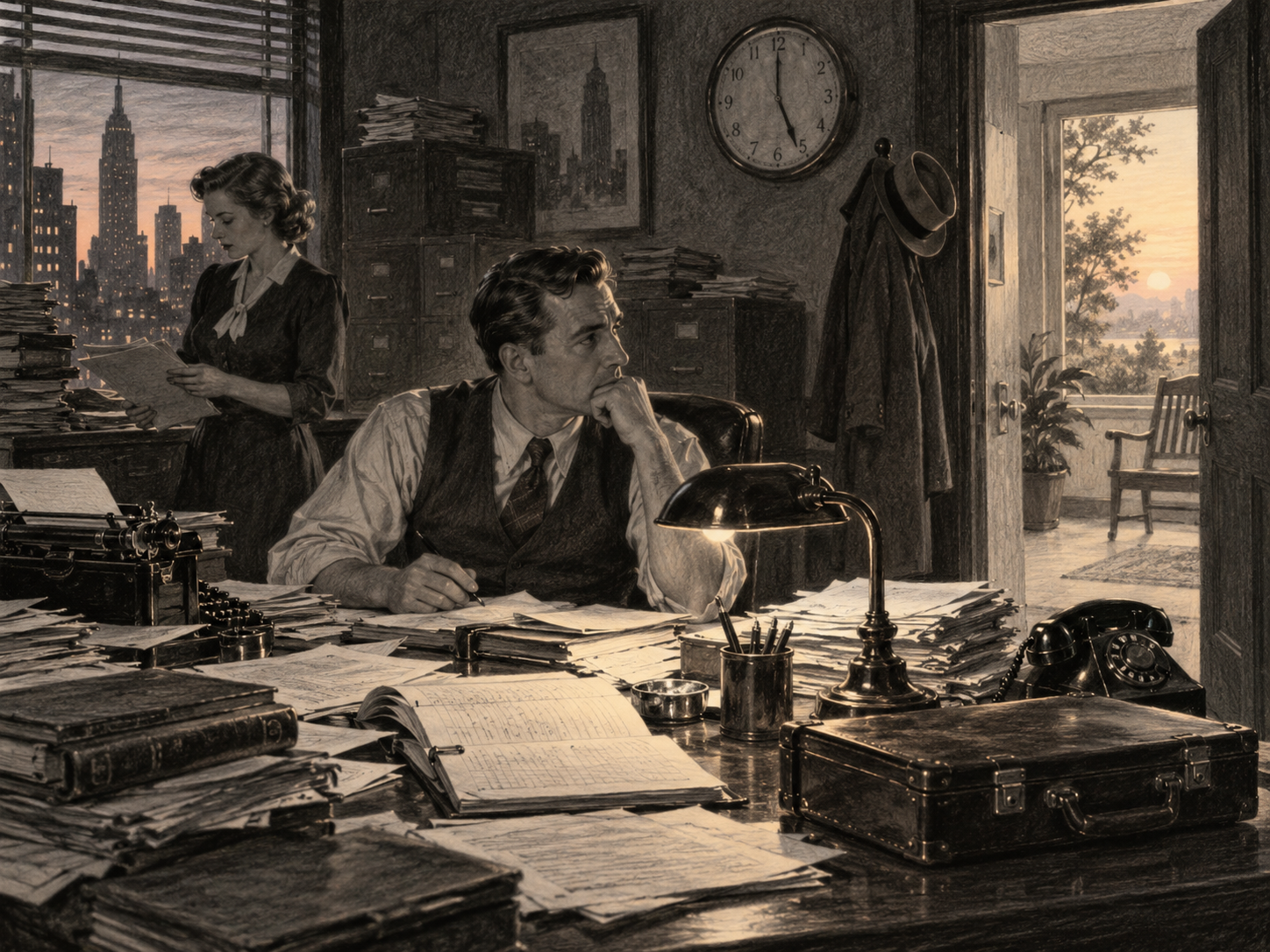
There will be ideas I never pursue. Things I never build. Books I never read. Places I never visit. Problems I never solve. There are dreams and ambitions for my life that will probably never be accomplished.
And I am at peace with that. Mostly.
Technology was supposed to help us with this.
In 1965, TIME reported that IBM economist Joseph Froomkin believed automation might eventually lead to a 20-hour workweek and what the magazine called a “mass leisure class.”
Thirty-five years before that, economist John Maynard Keynes had envisioned technological advancement eventually reducing work to about 15 hours a week.
How’s that going for us?
Technology absolutely made us more productive. The computer revolution changed what one person could accomplish. The internet accelerated it. Smartphones made our work portable.
And now we have artificial intelligence.
I use AI regularly and appreciate what it allows me to do. It saves me time. It helps me research, organize, process, create, and think.
You know what I’ve done with much of the time it saves me? The same thing you’ve done.
More stuff.
I have often told my wife that I could sit in a room with my computer, work for a couple of months straight, and still not get everything done.
The more I think about it, the more I realize that statement will likely be true for the rest of my life.
My to-do list will always be bigger than my calendar.
That realization doesn’t diminish my ambition. I still want to build. I want to serve people well. I want to love well. I want to contribute something meaningful. I have ideas I am excited about and work I believe I am supposed to do.
But somewhere in the middle of all of that is me. My heart. My mind. My body. My soul. And – apparently – God knew a long time ago that human beings would have trouble stopping.
Think about the world in which Sabbath was a norm.
There was no email. No cell phone. No text messages or Teams notifications. Nobody was checking sales numbers from the couch or answering one last message while standing in line at the grocery store. There was no global economy operating around the clock and no AI agent quietly generating more work while you slept.
One of your bigger Sabbath concerns was whether or not your donkey was going to fall into a well.
Seriously.
Their world was radically different from ours.
And they still needed Sabbath.
God built a stopping point into the always-demanding rhythm of human life. Jesus later reminded his listeners, “The Sabbath was made for man, not man for the Sabbath.” (Mark 2:27).
Sabbath. Made for us.
I find myself thinking about that more as technology advances, because one of the strange consequences of our increased productivity is that there are fewer natural stopping points.
Work used to stop because the sun went down. The field eventually ended. The store was closed. The office was somewhere else.
Those boundaries have largely disappeared in our world. I can work almost anywhere, almost anytime. And there is always something worthwhile I could be doing.
That last part matters to me.
The danger goes far beyond the idea that I might waste my life doing meaningless work. It’s that my life could be consumed doing more good work than I was designed to manage.
There is always another person I could help. Another idea I could pursue. Another opportunity worth considering. Another problem I am capable of solving.
So…if I am waiting until everything is finished before I rest, I will never rest. That goes for you, too.
It will never be finished.
Sabbath forces us to think about the demands of productivity from a different perspective. Can I willingly leave good work undone? Can I close the computer while there is still something important sitting in my inbox? Can I stop producing when I still have the capacity to produce?
Can I trust that the world can continue without my contribution for a while?
For me, Sabbath increasingly feels like more than physical recovery or good mental-health practice, though it certainly is those things.
More importantly, it’s a statement about who gets to own my life.
The world will take every ounce of productivity I am willing to give it. So will my ambition, if I let it. There is no finish line coming where all the boxes will finally be checked and I will have earned the right to stop.
Which means stopping has to be a choice. A protected choice.
This becomes even more important as AI increases what each of us is capable of doing. We are entering an age when the limitation may increasingly be less about what technology can accomplish and more about how much of our “selves” we are willing to give to everything it makes possible.
Maybe Sabbath is one of the ways we remember the difference.
So I will ask you a question that was posed to me just this past week as I openly reflected on my burgeoning opportunities:
When is your Sabbath?
Not, “When do you occasionally take a day off because you are exhausted?” Not, “When does your calendar happen to give you a break?”
When do you stop?
And are you willing to protect that time even when there is still good work left to do?
Because there always will be. Our to-do list will always be bigger than our calendar.
Blessings to you, my friends!
==========
This Week’s Resource Recommendation(s):
"24/6: A Prescription for a Healthier, Happier Life"
- Matthew Sleeth, M.D.
From Amazon: “Remember the Sabbath and keep it holy.”
Sounds nice, but how do we find rest in a 24/7 world? Just as the Hebrews were slaves in Egypt, we have become slaves to technology. Our technological tools allow 24-hour productivity and connectivity, give us more control, and subtlety enslave us to busyness itself. Sabbath is about restraint, about intentionally not doing everything all the time just because we can. Setting aside a day of rest helps us reconnect with our Creator and find the peace of God that passes all understanding. The Sabbath is about letting go of the controls one day a week and letting God be God. So how do we do it?
In 24/6, Dr. Matthew Sleeth describes our symptoms, clarifies the signs, diagnoses the illness, and lays out a simple plan for living a healthier, more God-centered life in a digitally-dazed, always-on world. Sleeth shares how his own family was dramatically transformed when it adopted Sabbath practices and helps readers better understand how their own lives can be transformed – physically, emotionally, relationally and spiritually – by adopting the 24/6 lifestyle.
==========
"The Shallows: What the Internet Is Doing to Our Brains"
- Nicholas Carr
From Amazon: Nicholas Carr’s bestseller The Shallows has become a foundational book in one of the most important debates of our time: As we enjoy the internet’s bounties, are we sacrificing our ability to read and think deeply? This 10th-anniversary edition includes a new afterword that brings the story up to date, with a deep examination of the cognitive and behavioral effects of smartphones and social media.
MMS 26-37
I would love to send our Monday Morning Stretch directly to you via email and would consider it an honor to serve you in this way. To register, please take 30 seconds to give us permission to do so below.
