
Under Pressure
Pressure is not the enemy of leadership.
It’s part of what makes it all work.
I pulled out of my driveway onto Route 116 and felt a rumble on acceleration. Nothing dramatic. But definite. Noticeable.
After a couple of miles it smoothed out. Still, something felt off. A quick glance at my mileage reminded me I was due for a tire rotation anyway, so I stopped in to see my friends at East Peoria Tire and asked them to take a look.
Turns out, one of my tires was running on 12 pounds of air.
Twelve.
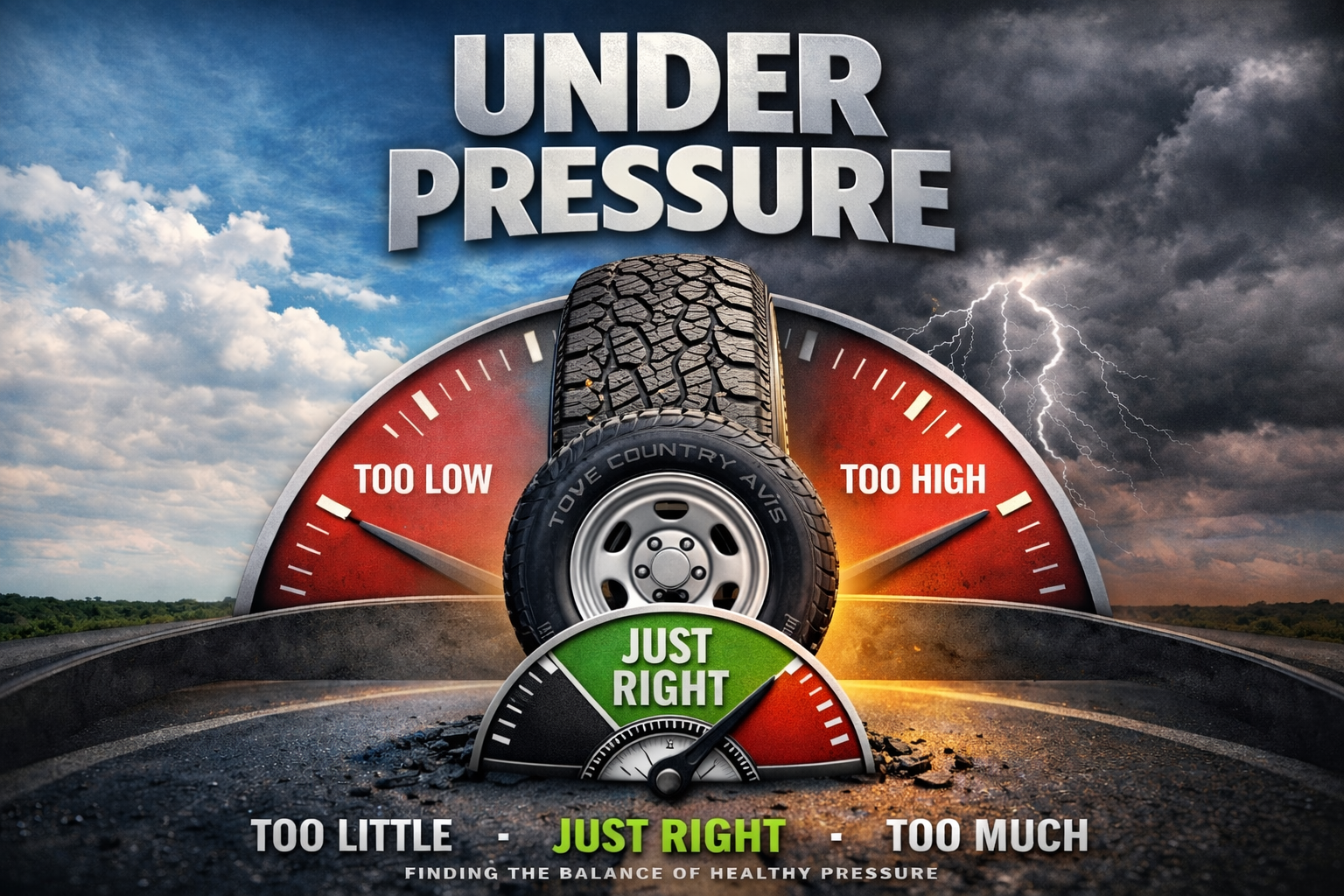
There was a nail in it. They patched it, rotated the tires, and sent me on my way. Smooth as silk. Riding like a champ again.
As I was driving away, it struck me. From the outside, the tire looked fine. You could hardly tell it was low.
But on that cold start? It was obvious.
Then once it “warmed up,” it seemed okay again. For a while.
That got me thinking – it’s not much different for you and me. From the outside, we can look fine. Especially once we get going. Once we “warm up.” Once we settle into the rhythm of the day.
But structurally, we may not be in a great place.
Pressure is an interesting thing. It sounds like something we should avoid. Something unhealthy. Something to minimize. But that is not entirely true.
Like our tires, we were designed to operate under a certain amount of pressure.
My vehicle is built to run with tires at 36 PSI. If the pressure is too low, the tire flexes too much. It overheats. It wears unevenly. Eventually, it fails.
If the pressure is too high, the ride becomes harsh. The margin for error shrinks. And under the wrong conditions, it can blow.
The goal is not to eliminate pressure. The goal is to run at the right pressure.
The same is true in leadership. Too little pressure, and we do not produce. We coast. We drift. We avoid hard things. Growth slows. In some cases, it stops altogether.
Jim Collins (Good to Great) observed that disciplined people, disciplined thought, and disciplined action are what separate great organizations from average ones. Discipline, by its very nature, introduces pressure. Without it, we tend to default toward comfort. And comfort, left unchecked, leads to atrophy.
On the other hand, too much pressure creates a different kind of problem. Leaders begin to fracture. Decision-making deteriorates. Relationships strain. Health declines. Eventually, something gives.
Stephen M.R. Covey and my good friends at WiLD Leaders often talk about the importance of trust as a stabilizing force in leadership. When pressure rises beyond what a system – or a person – can sustain, trust is often one of the first casualties.
And once trust erodes, everything else becomes harder.
Paul often spoke of the reality of this tension in his ministry:
We are hard pressed on every side, but not crushed; perplexed, but not in despair. – 2 Corinthians 4:8
There is pressure. But there is also design. And there are limits. We are not called to a pressure-free life. But we are also not built to be crushed by it.
Here is where this becomes deeply practical for leaders.
Your responsibility is not to eliminate pressure from your life or your organization. It is to calibrate it well.
For yourself. And for the people you lead. Too little, and your team will underperform. Too much, and they will burn out. The art of leadership lives in that tension.
The question of the day is: Where are you running right now?
Under-pressured – coasting more than you should? Or over-pressured – feeling the strain, even if you are still “holding it together” on the outside?
And what about your team? Are they operating at a level that allows them to grow, produce, and thrive, or are they quietly compensating for something that is off?
Because just like that tire…it may not be obvious at first glance. But it is always evident under load (like after a cold night, in less-than-ideal conditions, and being forced into service).
There is a kind of pressure that produces something good. The key is making sure it is the right kind. At the right level. Applied in the right way.
Consider it pure joy, my brothers and sisters, whenever you face trials of many kinds, because you know that the testing of your faith produces perseverance. Let perseverance finish its work so that you may be mature and complete, not lacking anything. – James 1:2 – 4
As leaders, we do not have the luxury of ignoring this. We are called to build environments where people can operate as designed. Where there is enough pressure to grow, but not so much that they break.
That is where great leadership lives. Not in the absence of pressure, but in the wisdom to apply it well – to both self and others.
==========
This Week’s Resource Recommendation(s):
"The Stress Paradox: Why You Need Stress to Live Longer, Healthier, and Happier―An Essential Stress Management Companion with a Mind-Body-Soul Approach"
- Sharon Horesh Bergquist, MD
From Amazon: What if we’ve gotten stress wrong?
There’s a breakthrough happening in the study of cellular health, wellness, and longevity. We know that excessive stress can be toxic, but emerging new research reveals that too little stress is just as bad for you as too much.
Dr. Sharon Bergquist, a pioneering physician and leading stress researcher, is at the forefront of this movement. In The Stress Paradox, she explains that our bodies are designed to heal and repair themselves, but we need the right amount and type of hormetic stress to rejuvenate at a cellular level.
Many modern comforts have inadvertently increased our risk of mental and physical illness by causing us to underutilize our inherited response to challenges. Our need for stress is so deeply embedded in our genes that you can’t achieve good health without it! Dr. Bergquist reveals how to optimize five key stressors to maximize mental, emotional, and physical resilience and reap a host of health benefits, from staving off dementia to increasing the years of your life. These simple lifestyle medicine changes can keep your mind sharp, improve your mood, increase energy and metabolism, support a healthy gut, maintain a healthy weight, and decrease your risk of serious diseases like cancer, heart disease, type 2 diabetes, and Alzheimer’s.
· Eating more plant “toxins” in foods like vegetables, dark chocolate, and spices
· Exercising with intermittent bursts of intense movement
· Engaging in heat and cold therapy to awaken your body’s ancient healing pathways
· Fasting most effectively for your circadian biology
· Challenging yourself mentally and emotionally while managing unhealthy stress levels
Rooted in cutting-edge science and complete with customizable protocols, workouts, and recipe templates, The Stress Paradox is an accessible life-changing roadmap for using hormesis to dramatically increase health, happiness, and longevity.
"The Comfort Crisis: Embrace Discomfort To Reclaim Your Wild, Happy, Healthy Self"
- Michael Easter
From Amazon: In many ways, we’re more comfortable than ever before. But could our sheltered, temperature-controlled, overfed, underchallenged lives actually be the leading cause of many our most urgent physical and mental health issues? In this gripping investigation, award-winning journalist Michael Easter seeks out off-the-grid visionaries, disruptive genius researchers, and mind-body conditioning trailblazers who are unlocking the life-enhancing secrets of a counterintuitive solution: discomfort.
Easter’s journey to understand our evolutionary need to be challenged takes him to meet the NBA’s top exercise scientist, who uses an ancient Japanese practice to build championship athletes; to the mystical country of Bhutan, where an Oxford economist and Buddhist leader are showing the world what death can teach us about happiness; to the outdoor lab of a young neuroscientist who’s found that nature tests our physical and mental endurance in ways that expand creativity while taming burnout and anxiety; to the remote Alaskan backcountry on a demanding thirty-three-day hunting expedition to experience the rewilding secrets of one of the last rugged places on Earth; and more.
Along the way, Easter uncovers a blueprint for leveraging the power of discomfort that will dramatically improve our health and happiness, and perhaps even help us understand what it means to be human. The Comfort Crisis is a bold call to break out of your comfort zone and explore the wild within yourself.
MMS 26-15
I would love to send our Monday Morning Stretch directly to you via email and would consider it an honor to serve you in this way. To register, please take 30 seconds to give us permission to do so below.
