
Every significant organizational movement eventually needs a champion.
Years ago, I watched a leadership transition that changed how I think about organizational influence.
The role was not described merely as a director, manager, or executive. The role was described as “Champion.”
At first, I thought the distinction was mostly semantic, but I was wrong. A director directs, a manager manages, and an expert advises.
But a champion creates movement.
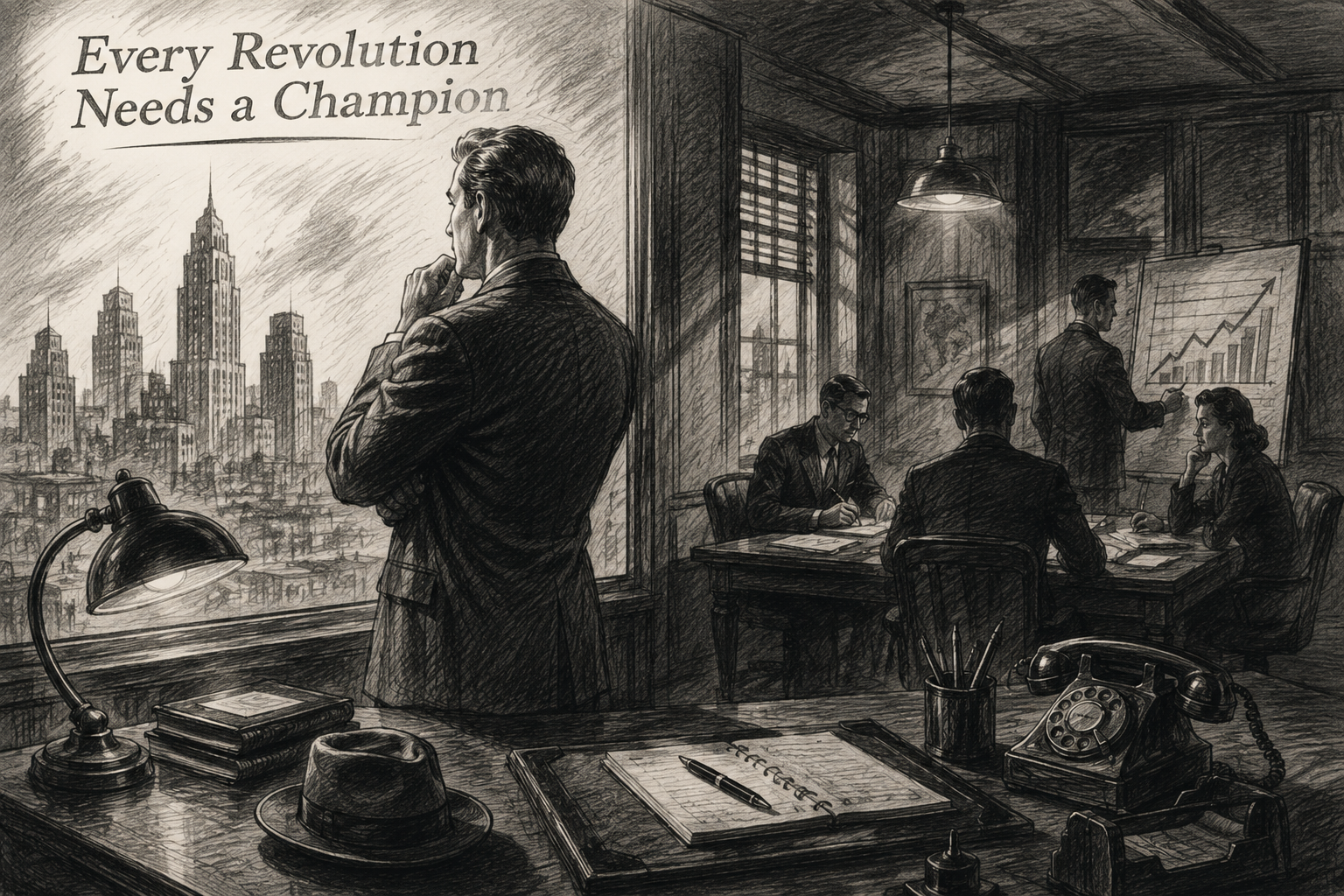
A champion believes deeply in the cause, communicates constantly (particularly in the early stages), and helps others see a future they may not yet fully understand. A champion doesn’t simply oversee the mission. A champion carries it, promotes it, protects it, and keeps it in front of the organization until it becomes part of the culture.
Culture initiatives need champions. Safety programs need champions. Customer experience efforts need champions. Leader development needs champions.
If you agree this to be the case, why would the most transformative technology shift of our generation be any different?
I am talking, of course, about artificial intelligence.
Most organizations are already using AI in some form. Employees are experimenting. Departments are testing. Leaders are exploring. Marketing is dabbling. Operations is curious. Sales is wondering what is possible. HR is asking questions.
Everyone is paddling. But in many organizations, nobody is steering. And that, my friends, is the leadership issue.
Most executive teams are asking, “How do we implement AI?” – which is an important question. But it may not be the first question.
The better question might be, “Who is championing AI in our organization?”
Not merely approving it, policing it, installing it, or experimenting with it.
Championing it.
Who wakes up every day thinking about how AI can help the organization become better?
Who is helping people overcome fear?
Who is identifying meaningful use cases?
Who is sharing early wins?
Who is encouraging adoption?
Who is helping departments learn from one another?
Who is making sure AI is used responsibly, ethically, and consistently?
Who is asking where AI should be used, where it should not be used, and how it can help people do better work?
That person may not be your best technician. They may not be your most advanced prompt engineer. They may not even sit in IT. But they must be someone who understands the organization, believes in the opportunity, respects the risks, and knows how to create momentum.
That is the difference between an AI user and an AI champion. A user asks, “How can AI help me?” A champion asks, “How can AI help us?” It’s a distinction that matters.
The AI revolution is so much more than a technology shift. It’s an organizational transformation issue. And organizational transformation requires leadership.
It requires vision, communication, training, standards, and trust. It requires a steady voice that says, “This matters, we are going to learn it together, and we are going to use it wisely.”
That is why I believe many organizations need more than an AI policy. Policy matters, of course. So do guardrails, data protections, accuracy, human oversight, and integrity.
But without a champion, AI can quickly become either scattered experimentation with no strategic alignment OR an over-controlled bureaucracy that kills curiosity before capability ever has a chance to grow.
The AI champion must live in the tension between enthusiasm and wisdom.
They are both cheerleader and guardian. They say, “Go faster.” And they say, “Be careful.” They say, “Experiment.” And they say, “Protect the company.” They say, “Think bigger.” And they say, “Stay grounded.”
They aren’t trying to replace human judgment. They are trying to strengthen human contribution. They aren’t trying to make the organization AI-only. They are trying to help the organization become AI-wise.
That may be one of the most important distinctions leaders need to make.
The goal is not to become impressed with technology. The goal is to become better stewards of the organization.
Better stewards of time.
Better stewards of talent.
Better stewards of decision-making.
Better stewards of opportunity.
Better stewards of the people entrusted to our care.
That is why this conversation belongs at the leadership table, not merely the technology table. IT may own infrastructure. Legal may help shape policy. Security may monitor risk. Department heads may own specific use cases.
But someone must own momentum. Someone must own adoption. Someone must own organizational learning. Someone must keep asking, “Are we becoming the kind of organization that can wisely and effectively leverage this new tool?”
Because what belongs to everyone often belongs to no one. And when no one owns the movement, the movement usually stalls.
Senior leaders understand this in other areas. If safety matters, we appoint safety champions. If culture matters, we identify culture carriers. If customer experience matters, we create ownership around the customer journey. If leader development matters, someone has to keep it alive when the urgent begins crowding out the important.
AI is no different. In fact…
Because of its speed, scale, and potential impact, AI may require even greater intentionality. This revolution is not slowing down.
The question is not whether AI will affect your organization. It will. The question is whether your organization will drift into it casually or move into it wisely.
Drift rarely produces excellence. Intentional leadership does. So perhaps the Monday morning question is simple:
Who is your AI champion?
Who is carrying the vision?
Who is creating momentum?
Who is helping your people learn?
Who is protecting integrity?
Who is connecting strategy to execution?
Who is making sure AI does not become “just another tool” people use randomly, but a capability your organization develops intentionally?
Every revolution needs a champion. The AI revolution is already here.
My MMS question for you today is: “Whom in your organization has been empowered to champion it?”
Blessings to you, my friends!
==========
This Week’s Resource Recommendation:
"Diffusion of Innovations, 5th Edition"
- Everett M. Rogers
From Amazon: In this renowned book, Everett M. Rogers, professor and chair of the Department of Communication & Journalism at the University of New Mexico, explains how new ideas spread via communication channels over time. Such innovations are initially perceived as uncertain and even risky. To overcome this uncertainty, most people seek out others like themselves who have already adopted the new idea. Thus the diffusion process consists of a few individuals who first adopt an innovation, then spread the word among their circle of acquaintances—a process which typically takes months or years. But there are exceptions: use of the Internet in the 1990s, for example, may have spread more rapidly than any other innovation in the history of humankind. Furthermore, the Internet is changing the very nature of diffusion by decreasing the importance of physical distance between people. The fifth edition addresses the spread of the Internet, and how it has transformed the way human beings communicate and adopt new ideas.
MMS 26-25
I would love to send our Monday Morning Stretch directly to you via email and would consider it an honor to serve you in this way. To register, please take 30 seconds to give us permission to do so below.
