
Every organization has its systems.
Systems for hiring, budgeting, production, quality, customer service, and more.
But do you have systems for humanity?
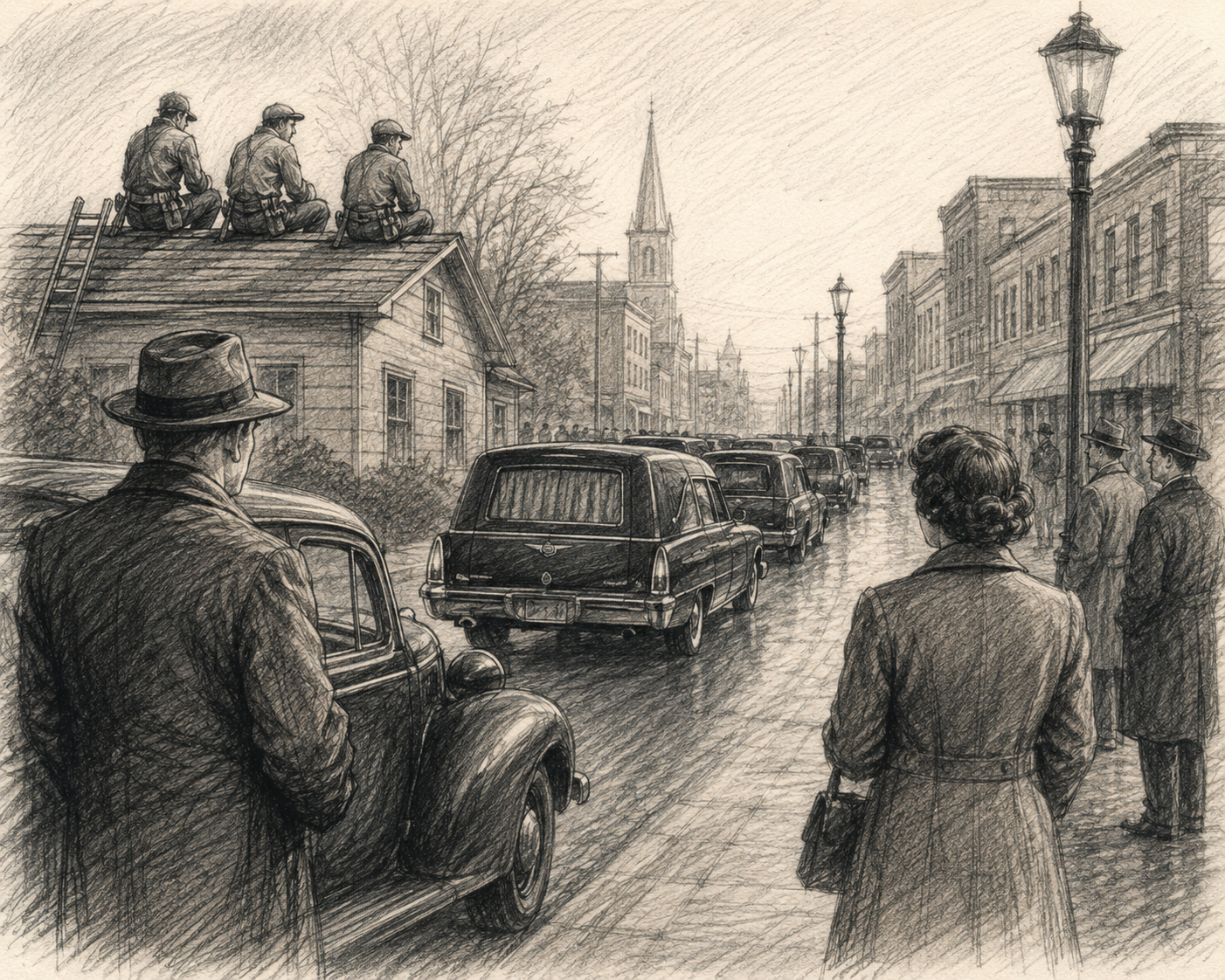
Years ago, as we were leaving my father-in-law's funeral and making our way to the cemetery, something etched itself into my memory.
Cars began pulling to the side of the road. Drivers stepped out of their vehicles. Everything slowed down.
Then I looked up and saw three roofers who had been working on an older home. As the funeral procession approached, they laid down their tools, sat quietly on the roof, and watched us drive by.
They likely had no idea whose funeral it was. They didn’t know the family. They didn’t know the story. But they knew enough to pause.
It put a lump in my throat.
The people pulling over, those standing by their cars, and the three on the roof all understood that, for a few brief moments, productivity needed to give way to humanity.
Over the past week, I attended two other funerals, one of which I had the privilege of officiating. Once again, I watched as people along the route pulled aside to allow the procession to pass. County highways with semi’s pulled to the side. Cars holding back on the expressway so as not to pass the procession.
Complete strangers acknowledging that someone’s life mattered.
I realize that this isn’t common everywhere. Perhaps that’s one of the reasons it continues to move me so deeply. I am grateful to still live close enough to small-town America to witness moments like these, reminders that life is still worthy of honor, even when we don’t know the person being honored.
As I reflected on those processions, my thoughts naturally drifted toward the life of a leader. (Sorry… It’s how I’m wired.)
Executive leaders carry enormous responsibility. We are entrusted with organizations, strategies, budgets, customers, investors, deadlines, and performance. Those responsibilities matter.
But so do the people who carry them.
Every person who walks through the doors of our organizations brings an entire life with them. They bring marriages, children, aging parents, hopes, disappointments, victories, fears, dreams, and heartbreak. None of that disappears when they clock in on Monday morning.
Nor does death.
That’s not meant to be a morbid observation. It is simply an honest one.
Life eventually touches every one of us with celebrations we never imagined and losses we never wanted.
It’s not a matter of whether those moments will come. They will.
Do our organizations know what to do when those days come. (Yes, our organizations.)
Most companies have remarkably well-designed systems. We know how to onboard a new employee, process payroll, complete annual reviews, and measure productivity.
But have we given equal thought to the moments that define a person's life? Do we know what happens...
the day someone gets married?
the day their first child is born?
the day their son or daughter graduates?
the day they become grandparents?
the day a cancer diagnosis changes everything?
the day they lose a parent?
the day they bury a spouse?
the day tragedy unexpectedly visits their home?
Are those moments left to chance? Or have we intentionally built a culture that knows exactly how to respond?
Purpose-driven leaders understand that compassion cannot depend solely upon the personality of a manager. It must become part of the operating system of the organization itself.
That may look like clear bereavement policies. It may involve meals delivered to a grieving family. It may be a leadership team that shows up at a visitation. It may be flexibility without someone having to ask for it.
It may simply be creating the kind of culture where people know they will never have to choose between being fully human and being fully employed.
These are not interruptions to business. They are part of the stewardship of leadership.
Carry each other's burdens, and in this way you will fulfill the law of Christ. – Galatians 6:2
Notice that Paul does not describe an occasional act of kindness. In the broader passage, he is calling us to an ongoing way of life.
That sounds remarkably like a system.
And our systems reveal our values.
The strongest cultures are not built by mission statements hanging on a wall. They are built by repeated actions that consistently communicate what matters most. Over time, those repeated actions tell every employee exactly what is honored inside an organization.
Every funeral procession reminds me of that truth. For a few brief moments, traffic stops. Schedules wait. Deadlines can be delayed. Complete strangers quietly acknowledge that a human life is worthy of honor.
What if our people experienced that same conviction long before their funeral?
What if they knew, through the ordinary rhythms of everyday leadership, that they were valued not simply for what they produced, but for who they were?
Perhaps our organizations would become healthier if we learned to lead that way.
Healthy organizations don’t wait for compassionate leaders to come along and do the right thing once in a while.
They build compassionate cultures.
And perhaps that is one of the greatest legacies a leader can leave behind. Not simply an organization that performed well, but one where people knew their lives – and the lives of those they loved – mattered.
Blessings to you, my friends!
==========
This Week’s Resource Recommendation:
"Everybody Matters: The Extraordinary Power of Caring for Your People Like Family"
- Bob Chapman & Raj Sisodia
From Amazon: Starting in 1997, Bob Chapman and Barry-Wehmiller have pioneered a dramatically different approach to leadership that creates off-the-charts morale, loyalty, creativity, and business performance. The company utterly rejects the idea that employees are simply functions to be moved around, “managed” with carrots and sticks, or discarded at will. Instead, Barry-Wehmiller manifests the reality that every single person matters, just like in a family. It’s not a cliché on a mission statement; it’s the bedrock of the company’s success.
It’s natural to be skeptical when you first hear about this approach. Every time Barry-Wehmiller acquires a company whose team members have experienced more traditional management practices, the new team members are skeptical too. But they soon learn what it’s like to work at an exceptional company where the goal is for everyone to feel trusted and cared for—and where it’s expected that they will justify that trust by caring for one another and putting the common good first.
Chapman and coauthor Raj Sisodia show how any organization can reject the traumatic consequences of rolling layoffs, dehumanizing rules, and hypercompetitive cultures. In this tenth anniversary update to Everybody Matters, Chapman and Sisodia share new statistics and analysis on the leadership crisis that continues to plague modern businesses and that only Truly Human Leadership—pioneered at Barry-Wehmiller—can fix. Packed with additional insights gained over a decade as the company has evolved, weathered a pandemic, and grown from $1.7 billion in annual revenue with 100 acquisitions to $3.6 billion with more than 140 acquisitions, this updated classic is needed now more than ever.
As Chapman says, “The way we lead impacts the way people live.” Once you stop treating people like functions or costs, disengaged workers begin to share their gifts and talents in service of a shared future. Uninspired workers stop feeling that their jobs have no meaning. Frustrated workers stop taking their bad days out on their spouses and kids. And everyone stops counting the minutes until it’s time to go home. This is the journey documented in Everybody Matters; now it’s time to transform your own workplace.
MMS 26-26
I would love to send our Monday Morning Stretch directly to you via email and would consider it an honor to serve you in this way. To register, please take 30 seconds to give us permission to do so below.
